John Singer Sargent の The Sitwell Family の専門的な分析
スタイル:Realism · ジャンル:portrait
Expert Analysis: "The Sitwell Family" by John Singer Sargent
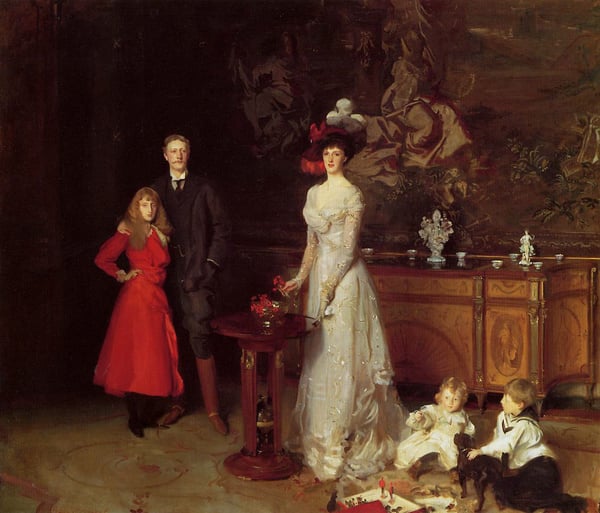
John Singer Sargent’s The Sitwell Family (1900) exemplifies the pinnacle of realist portraiture in the Edwardian era, merging formal elegance with psychological depth. Executed in a period when Sargent was the most sought-after portraitist among the Anglo-American elite, this work transcends mere likeness to become a study of lineage, status, and the subtle dynamics of family identity.
Composition and Realist Technique
True to the realist style, Sargent renders each figure with meticulous attention to texture, light, and posture. The family—Sir George Sitwell, his wife Lady Ida, and their three children, Edith, Osbert, and Sacheverell—is arranged in a seemingly casual yet carefully balanced grouping. Sargent’s signature bravura brushwork defines the sheen of silk, the softness of lace, and the glint of jewelry, while the swift, confident strokes of the background suggest an interior of aristocratic comfort. The naturalistic lighting, falling from an unseen source to the left, models faces and hands with a soft clarity that avoids the stiff formality of earlier Victorian portraiture.
Significance within Sargent’s Oeuvre
This painting is significant for its departure from Sargent’s earlier grand-manner solo portraits (e.g., Madame X). Here, he undertakes the challenge of a multi-generational group, orchestrating a conversation between individual personalities and collective unity. The children are not mere accessories; young Edith’s direct gaze, Osbert’s self-contained stance, and Sacheverell’s slightly more distant pose hint at the creative and eccentric futures that would define the Sitwell siblings as literary trailblazers. Sargent’s realism captures not only their physical traits but also the familial tension—Sir George’s patrician reserve contrasts with Lady Ida’s softer, more anxious expression, foreshadowing the family’s later well-documented conflicts.
Context and Lasting Influence
The Sitwell family were notable patrons and subjects of the arts, and Sargent’s portrait became a defining image of the British cultural aristocracy at the turn of the century. Its significance lies in how Sargent synthesizes the objectivity of Realism with the emerging modern interest in psychological portraiture. Unlike the idealized court portraits of previous centuries, this work presents the Sitwells as complex individuals within a specific social milieu, making it a touchstone for understanding how portraitists of the era navigated authenticity and iconography. Today, it stands as a masterful example of Sargent’s ability to make a group portrait feel both monumental and intimate—a testament to his unerring eye for human character and his realist command of paint.
Museum / Gallery
視覚的に類似
構図やパレットが近い作品 20 件
The reluctant bride
Auguste Toulmouche
Portrait of Consuelo Vanderbilt, 9th Duchess of Marlborough
Umberto Veruda
The young suitor
Francesco Beda
Young woman in pink with her child
Pascal Dagnan-Bouveret
Hylda, Daughter of Asher and Mrs. Wertheimer
John Singer Sargent
A Testing Question
Frederick Morgan
The primers
Jehan Georges Vibert
Chess Players
Giulio Rosati
The art lesson
Francesco Beda
The Wyndham Sisters
John Singer Sargent
Fiesta elegante
Francisco Miralles
The Misses Hunter
John Singer Sargent
Portrait of Grand Duchess Elena Pavlovna and Her Daughter Maria
Karl Bryullov
Courtship
Francesco Didioni
A Family Group, The Artist's Wife and Children, 'Papa Painting!'
Solomon Joseph Solomon
Redemption
Julius LeBlanc Stewart
The finishing touch
Wladyslaw Czachorski
Portrait of the Countess of Clary Aldringen
John Singer Sargent
Untitled
Ferdinand Georg Waldmüller
Chopin Playing the Piano in Prince Radziwill's Salon
Henryk Siemiradzki