Expert analysis of John Singer Sargent’s Breakfast in the Loggia
Style: Impressionism · Genre: genre painting
Expert Analysis: Breakfast in the Loggia by John Singer Sargent
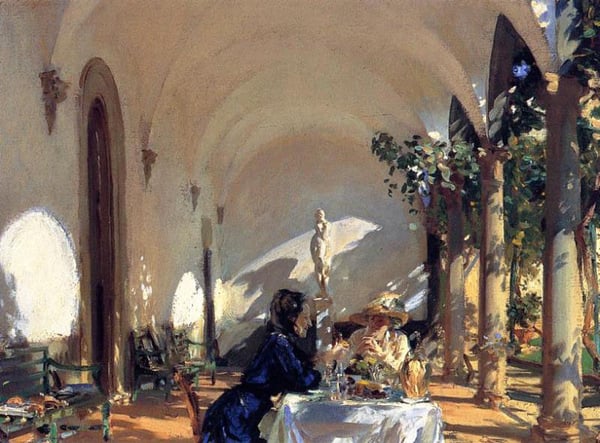
John Singer Sargent’s Breakfast in the Loggia stands as a compelling testament to his mastery of Impressionist light and atmosphere, even as he remained somewhat apart from the movement’s strict Parisian orthodoxy. Painted during his formative years—likely in the late 1870s or early 1880s, when he was deeply influenced by Claude Monet and his circle—this genre scene captures a fleeting, intimate moment in a sun-drenched outdoor setting.
Significance within Impressionism
The work exemplifies key Impressionist concerns: the play of natural light, dappled shade, and the suggestion of transient sensory experience. Sargent renders the loggia’s architecture and the white tablecloth with brisk, broken brushwork that dissolves form into shimmering patches of color. The figures—two women and a child—are not the primary focus; rather, they become part of the overall harmony of light, shadow, and reflection. The painterly handling of the breakfast table, with its glinting silver, translucent glassware, and soft-edged fruit, demonstrates Sargent’s ability to capture the momentary effects of sunlight filtering through leaves.
Genre Scene as Modern Life
As a genre painting—a depiction of everyday life—Breakfast in the Loggia elevates a casual domestic ritual into a study of refined leisure. This aligns with Impressionism’s broader fascination with modern bourgeois activities (think Renoir’s Luncheon of the Boating Party or Monet’s Déjeuner sur l’herbe). However, Sargent injects a distinctive note of elegant spontaneity. The composition is asymmetrical, with the loggia’s columns creating a theatrical framing device that pulls the viewer’s eye into the sunlit space beyond.
Significance in Sargent’s Oeuvre
While Sargent is best known for his polished society portraits, Breakfast in the Loggia reveals his virtuosity in a looser, more atmospheric mode. It anticipates his later watercolors and oil sketches, where he would continue to explore the interplay of light and texture. The painting also underscores his skill at synthesizing Impressionist techniques with a crisp compositional clarity—a balance that sets him apart from more radical Impressionists. Here, the fleetingness of light is captured without sacrificing the solidity of the scene, making the work a bridge between academic discipline and avant-garde spontaneity.
Conclusion
Breakfast in the Loggia is significant because it demonstrates John Singer Sargent’s sophisticated engagement with Impressionism while asserting his unique voice. It is a luminous, intimate genre scene that celebrates the beauty of ordinary life in extraordinary light—a hallmark of his most enchanting work.
Visually similar
20 works with related composition and palette
Villa Torre Galli The Loggia
John Singer Sargent
Hospital at Granada
John Singer Sargent
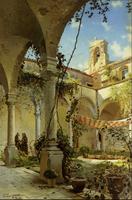
The Cloister, Taormina
Peder Monsted
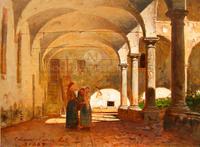
Cloister interior
Vincenzo Cabianca
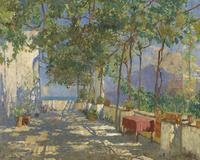
Patio in Capri
Konstantin Gorbatov
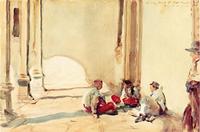
A Spanish Barracks
John Singer Sargent
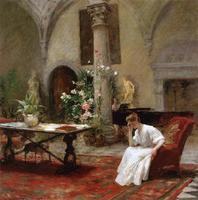
The Song
William Merritt Chase
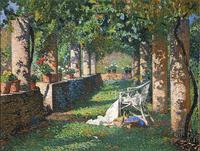
The Pergola in Spring
Henri Martin
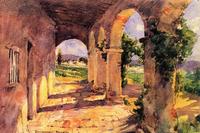
Corridors of San Juan Capistrano
Benjamin Brown
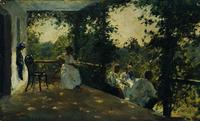
On the terrace
Ilya Repin
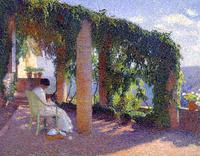
Woman Sewing on a Veranda
Henri Martin
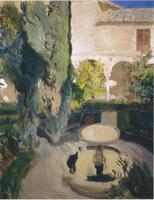
Garden of Lindaraja
Joaquín Sorolla
Italian Landscape
Henryk Siemiradzki
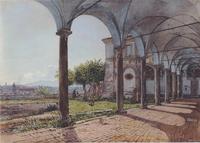
View from the Monastery of Sant 'Onofrio in Rome
Rudolf von Alt
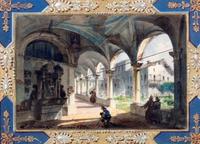
Devotion in the cloister
Luigi Premazzi
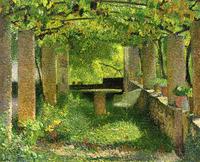
The Arbour
Henri Martin
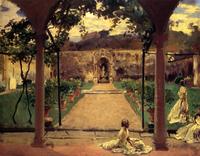
At Torre Galli. Ladies in a Garden
John Singer Sargent
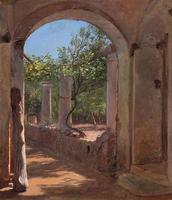
View of an Italian garden with the picturesque remains of a colonnade
Ernst Meyer
Rose Bush at the Sorolla House
Joaquín Sorolla
Patio Interior
Manuel Garcia y Rodriguez