Expert analysis of John Singer Sargent’s Robert Louis Stevenson
Style: Realism · Genre: portrait
Expert Analysis: "Robert Louis Stevenson" by John Singer Sargent
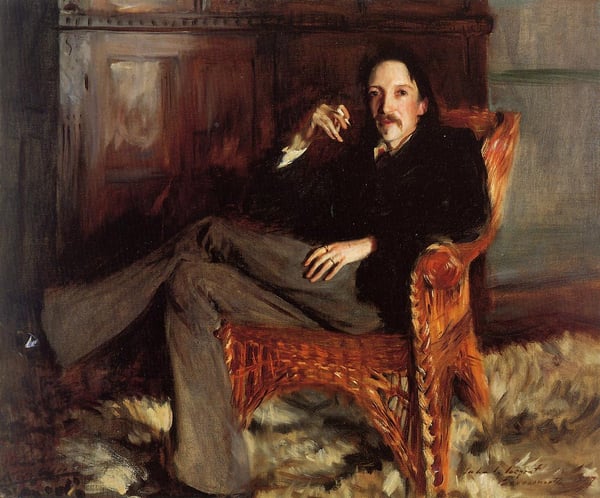
John Singer Sargent’s portrait of Robert Louis Stevenson is a masterwork of Realism, demonstrating the artist’s extraordinary ability to merge technical precision with profound psychological insight. Painted in 1885, this portrait captures the celebrated Scottish author not in a formal, idealized pose, but in a candid, almost conversational moment—a radical departure from the stiff convention of traditional portraiture.
Significance within Realism and Portraiture:
-
Intimate, Unconventional Composition: Sargent depicts Stevenson standing at an angle, one hand in his pocket, the other holding a cigarette, with his sharp, intense gaze directed slightly away from the viewer. This informal stance—more "snapshot" than studio pose—reflects Realism’s commitment to capturing life as it is lived, not as it is staged. The choice to show Stevenson in a domestic, twilit interior, rather than a grand setting, emphasizes his human vulnerability over his public persona.
-
Psychological Depth: Sargent’s Realism goes beyond surface likeness. The sallow complexion, the thin, nervous fingers, and the dark, penetrating eyes all hint at Stevenson’s chronic ill health (he suffered from lung disease) and his restless, creative energy. The darkened background and the subtle, smoky atmosphere isolate the figure, making his introspective mood almost tangible. This is not just a record of a face, but a window into a mind—a hallmark of Sargent’s best portraits.
-
Mastery of Light and Tone: True to Realist principles, Sargent uses a restrained, subdued palette—deep browns, blacks, and muted grays—with only the sitter’s pale face and white collar catching the dim light. The soft, diffused illumination models the features with a naturalistic, almost photographic exactness, while the loose, expressive brushwork (especially in the coat and hair) avoids the slick polish of academic painting, lending the work a vivid, living quality.
-
Cultural and Historical Significance: Stevenson was a literary giant of his era, and Sargent was the preeminent portraitist of the Anglo-American elite. This portrait captures a moment of intimate friendship (the two were neighbors in Bournemouth, England), and its informal nature reflects the shifting values of late‑19th‑century portraiture: away from grand narrative and toward personal, psychological realism. It remains one of the most iconic images of Stevenson, immortalizing the author not as a remote genius, but as a restless, contemplative man—a perfect fusion of Realist technique and human truth.
In sum, Sargent’s Robert Louis Stevenson is significant not only as a technical tour de force but as a landmark in the evolution of portrait Realism, where accuracy of observation serves the deeper goal of revealing character.
Museum / Gallery
Visually similar
20 works with related composition and palette
Henri De Gas and His Neice, Lucie Degas
Edgar Degas
Portrait of Paul Nauen
Olga Boznańska
Stephane Mallarme
Edouard Manet
Portrait Of Alexander Cassatt
Mary Cassatt
Portrait of Prince Vladimir Mikhailovich Golitsyn
Valentin Serov
Manuel Gustavo Bordalo Pinheiro
Columbano Bordalo Pinheiro
Portrait of the artist's father
Marcel Duchamp
Portrait of the Artist I.S. Ostroukhov
Valentin Serov
Portrait of Maxim Gorky
Ilya Repin
Paul Leclercq
Henri de Toulouse-Lautrec
Seated Young Man in a Jacket with an Umbrella
Edgar Degas
Portrait of D.F. Bogoslovsky
Boris Kustodiev
Portrait of the artist Isaak Ilyich Levitan
Valentin Serov
Man reading (Father)
Walter Gramatté
Gustave Lucien Dennery
Henri de Toulouse-Lautrec
The Painter Benito Soriano Murillo
Raimundo de Madrazo
Portrait of B.A. Kaminka
Ilya Repin
Portrait of the Artist’s Father, the Innkeeper Erik Brøndum
Anna Ancher
Portrait of Dr. William Thompson
Thomas Eakins
Retrato de Luis G. Urbina
Dr. Atl