John Singer Sargent の Boy on a Rock の専門的な分析
スタイル:Impressionism · ジャンル:genre painting
Expert Analysis of Boy on a Rock by John Singer Sargent
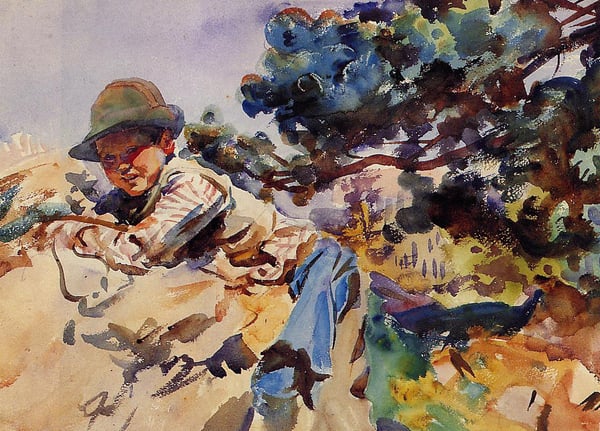
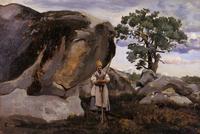
John Singer Sargent’s Boy on a Rock exemplifies the artist’s mastery of Impressionism — a style he adopted during his travels and plein-air experiments — while also functioning as a genre painting that captures a candid, everyday moment. Unlike Sargent’s celebrated society portraits, which often emphasize formality and psychological depth, this work shifts focus to light, atmosphere, and the transient beauty of childhood leisure.
Significance within Style and Period:
- Impressionist Techniques: Sargent employs loose, rapid brushstrokes to render dappled sunlight filtering through leaves, shimmering on the boy’s clothing and the rock’s surface. The palette is bright but naturalistic, with subtle blues, greens, and warm earth tones that evoke the freshness of the outdoors. The composition feels spontaneous — the boy’s relaxed pose and averted gaze suggest a snapshot caught mid-moment, a hallmark of Impressionism’s rejection of staged studio scenes.
- Genre Painting Revival: By choosing a seemingly trivial subject — a young boy resting on a sunlit rock — Sargent elevates a simple, unposed activity to the level of fine art. This aligns with the Impressionist goal of finding beauty in modern life and ordinary experiences, challenging the era’s preference for historical or allegorical themes.
- Sargent’s Unique Voice: While many Impressionists focused on landscapes or urban scenes, Sargent infused his genre works with a portraitist’s sensitivity. The boy’s identity remains anonymous, yet Sargent captures an intimate, contemplative mood — the slight tilt of the head, the relaxed curve of the spine — granting the figure a quiet dignity that resonates beyond the canvas.
Art Historical Context:
Painted during Sargent’s prolific period in the late 1880s–1890s, Boy on a Rock reflects his travels to the English countryside and the Alps, where he often sketched en plein air. The painting demonstrates his ability to merge Impressionist luminosity with the solidity of form derived from his academic training. This synthesis — fleeting light rendered through controlled yet lively brushwork — marks Sargent as a bridge between traditional portraiture and modern painterly freedom.
Why It Matters:
The work is significant as a testament to Sargent’s versatility beyond elite portraiture. It showcases his observational prowess and his commitment to capturing the ephemeral, whether in the shimmer of sunlight on water or the quiet stillness of a boy at rest. For viewers, Boy on a Rock offers a window into Sargent’s private, more spontaneous artistic side, where the grand portraitist becomes a poet of ordinary sunlight and solitude.
Museum / Gallery
視覚的に類似
構図やパレットが近い作品 20 件
Study of lying boy
Nicholas Roerich
The halted Pilgrimage (The assistance)
Ferdinand Georg Waldmüller
The berry pickers
Winslow Homer
Grape Picker in a Cap I
Frederic Bazille
The Whittling Boy
Winslow Homer
Tatar Woman Coming from the Well
Rudolf Schweitzer-Cumpana
The Young Routy Céleyran
Henri de Toulouse-Lautrec
Goat Herder at the San Antonio Quarry
Robert Julian Onderdonk
O Emigrante
Jose Malhoa
Children building a fire
Enrico Nardi

To the field
Vaclav Brozik
Turning the Soil
Tom Roberts
The young botanist
Paul Peel
A Girl Rollingup Her Sleeves. Study for 'Bread'
Tetyana Yablonska
Carrara Workmen
John Singer Sargent
On a Peak
Nicolae Grigorescu
Roceira
Georgina de Albuquerque
Girl sitting in the grass
Emmanuel Zairis
Alenushka
Viktor Vasnetsov
The Forest of Fontainebleau
Camille Corot