Expertenanalyse zu John Singer Sargents Engelsburg
Stil: Realism · Genre: landscape
Expert Analysis of John Singer Sargent’s Engelsburg
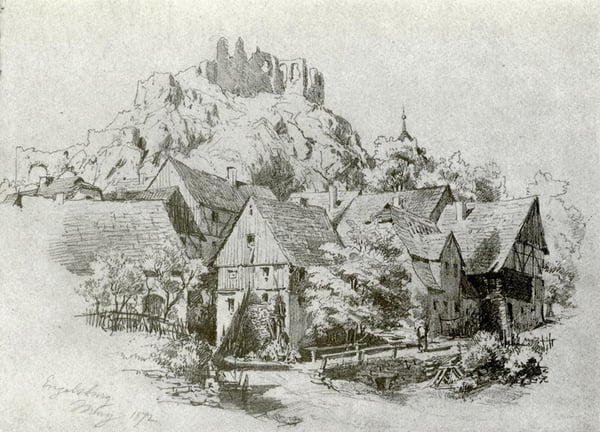
John Singer Sargent is best known for his dazzling society portraits, yet his landscape works—particularly those executed during his travels—reveal a master of light, atmosphere, and architectural precision. Engelsburg (the German name for Rome’s Castel Sant’Angelo) belongs to Sargent’s Realist mode, but it is a Realism infused with the spontaneity of Impressionism.
Significance within Style and Period:
- Realist foundation, Impressionist sensibility: Sargent anchors the composition in clear, legible forms—the massive cylindrical bulk of the castle, the bridge’s stone arches, the Tiber’s flow—yet handles light and shadow with feathery, broken brushstrokes that capture the shimmer of Roman afternoon sun. This blend exemplifies Sargent’s late-career freedom, where academic draftsmanship yields to a more painterly, atmospheric vision.
- Architecture as character: Unlike many Realist landscapes that prioritize rural scenes or humble life, Sargent elevates a historic monument into a living, breathing subject. The castle’s warm ochre and brown tones are set against a cerulean sky and the cool green-gray river, creating a dialogue between human-made grandeur and natural light.
- Viewpoint and immediacy: Sargent paints from a low angle, likely from the Ponte Sant’Angelo, making the fortress loom with quiet majesty. The inclusion of small figures and a passing cart on the bridge gives scale and a sense of fleeting daily life—a Realist concern for the moment within the eternal city.
What Makes It Significant:
Engelsburg demonstrates that Sargent’s Realism was not a rigid doctrine but a flexible tool for capturing optical truth—the way the eye perceives mass, light, and air. The work is a testament to his ability to synthesize the discipline of the École des Beaux-Arts with the innovative color and brushwork of the Impressionists, all while retaining a distinctly architectural clarity. For scholars, it represents Sargent’s quieter, more contemplative side: a landscape that speaks not of social status but of the serene grandeur of place.
Museum / Gallery
Visuell ähnlich
20 Werke mit ähnlicher Komposition und Farbpalette
Landscape with a Cow Drinking
Rembrandt
Journey to the Center of the Earth
Edouard Riou
Village View
Master of the Small Landscapes
Farms in a Village from Regiunculae Et Villae Aliquot Ducatus Brabantiae
Master of the Small Landscapes
Country Village, Archers in the Foreground from Multifariarum Casularum Ruriumque Lineamenta Curiose Ad Vivum Expressa
Master of the Small Landscapes
A Village Road, Plate 7 from Regiunculae Et Villae Aliquot Ducatus Brabantiae
Master of the Small Landscapes
Buildings at Aylesbury
Thomas Girtin
Aquafort Jerzual Street in Dinan (with Cat)
Józef Pankiewicz
Moonlight Street, Pont-de-l'Arche
Clarence Gagnon
Berglandschaft mit Mühle
Johann Joseph Jansen
The Unsafe Tenement
James McNeill Whistler
Galluis study
Theophile Steinlen
Large Walled Farm, Plate 23 from Regiunculae Et Villae Aliquot Ducatus Brabantiae
Master of the Small Landscapes
Village Road, plate 3 from Regiunculae et Villae Aliquot Ducatus Brabantiae
Master of the Small Landscapes
The town Traben Trarbach and the Grevenburg on the Moselle River in Germany
Karl Bodmer
Moonlight Street, Pont-de-l'Arche
Clarence Gagnon
Margaret's Garden
Konstantin Korovin
Village at the Wood's Edge
Jacob van Ruisdael
Farmstead in Spring
Carl Julius von Leypold
From the Black Forest
Hans Brunner