Analisi esperta di Ilex Wood, Majorca di John Singer Sargent
Stile: Realism · Genere: landscape
Expert Analysis: "Ilex Wood, Majorca" by John Singer Sargent
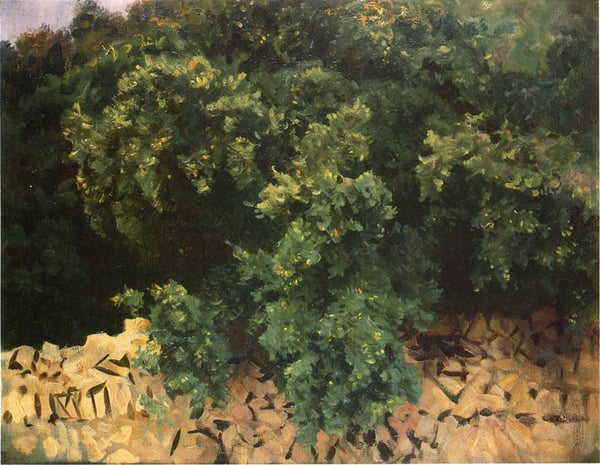
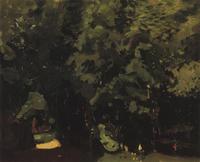
John Singer Sargent is celebrated worldwide for his luminous society portraits, but his less-frequently discussed landscape works—such as Ilex Wood, Majorca—reveal a master equally adept at capturing the quiet, meditative power of nature. Executed during his travels on the Balearic island of Majorca, this painting exemplifies the Realist tradition while simultaneously showcasing Sargent’s distinctive, fluid handling of light and atmosphere.
What makes this artwork significant:
-
A Departure from the Portrait Studo – Sargent’s landscapes often served as private, experimental releases from the demands of portraiture. Here, he turns his eye to the dense, dappled interior of an ilex grove (holm oak), a subject that demands acute observation of foliage, shadow, and the interplay of filtered sunlight. The work is a testament to his ability to shift from the high-society drama of a likeness to the serene, unpeopled poetry of a forest.
-
Mastery of Light in a Realist Framework – True to Realist principles, Sargent does not idealize the scene; instead, he records the particular, transient effects of light as it pierces the canopy. Patches of bright, almost Impressionistic highlights dance across the tree trunks and forest floor, while deep, brooding shadows anchor the composition. This creates a palpable sense of depth and enclosure, inviting the viewer to step into the cool, shaded air of the Majorcan woods.
-
Bold, Painterly Execution – Though rooted in Realism, Sargent’s brushwork in Ilex Wood, Majorca is rapid and confident. He builds the dense network of branches and leaves with swift, intuitive strokes—some thin and sketch-like, others thick with impasto. This method foreshadows the looser, more expressive treatments of later plein-air painters, placing Sargent as a bridge between 19th‑century academic Realism and early modernist landscape traditions.
-
Archival of a Vanished Landscape – Majorca in the late 19th century was a pastoral, undeveloped retreat for artists. Sargent’s choice to focus on an ancient ilex wood immortalizes a site that would later face agricultural and touristic pressures. The painting thus holds historical value as a document of a specific, untouched Mediterranean ecosystem captured before industrialization.
In stylistic context: Within Sargent’s own oeuvre, Ilex Wood, Majorca stands alongside his finest plein‑air studies—works like Carnation, Lily, Lily, Rose (1885) or his Venetian scenes—where atmosphere and light become the true subjects. Yet unlike those sun‑drenched or twilight pictures, this Majorcan interior is cool and introspective, demonstrating that Realism is not merely about rendering “what is there,” but about evoking the sensory experience of place. For scholars and collectors, it represents the Private Sargent: the restless observer who found as much fascination in the pattern of leaves against a stone wall as in the silk‑clad shoulders of a Gilded Age heiress.
Museum / Gallery
Visivamente simili
20 opere con composizione e palette affini
Akhtyrsky oak
Viktor Vasnetsov
Stone Fence
Otto Bache
Lover's Walk, Dolgelly
Thomas Stuart Smith
Oaks in sunlight
Ivan Shishkin
Landscape
Benjamin Champney
Fontainebleau Black Oaks of Bas Breau
Camille Corot
Road near Cagnes
Pierre-Auguste Renoir
Landscape
Edward Mitchell Bannister
Summer Landscape (Summertime)
Joseph DeCamp
Landscape with Rose Trellis
John Singer Sargent
Oak trunk in early summer
Isaac Levitan
Branchville
John Henry Twachtman
Trees
Ivan Shishkin
Texas Dry Country
Robert Julian Onderdonk
Landscape
Camille Corot
Bushes
Pyotr Konchalovsky
Fountainebleau With Georges d'Apremont
Camille Corot
Blossoms
Childe Hassam
Park
Konstantin Somov

Lane in the Woods
Pierre-Auguste Renoir