Expert analysis of John Singer Sargent’s In the Alps
Style: Impressionism · Genre: landscape
Expert Analysis of "In the Alps" by John Singer Sargent
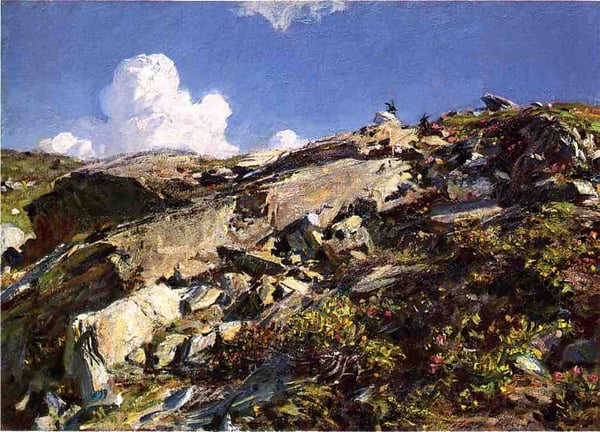
John Singer Sargent’s In the Alps is a striking example of the artist’s engagement with Impressionist landscape painting, a genre he pursued alongside his celebrated portraiture. Though best known for his polished society portraits, Sargent’s landscapes reveal a freer, more experimental side—and In the Alps stands as a testament to his ability to capture the transient effects of light and atmosphere in a high-altitude setting.
Stylistic Significance within Impressionism
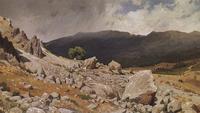
Painted in the late 19th or early 20th century, the work exemplifies the core Impressionist concern with plein air observation and optical truth. Sargent employs a brisk, broken brushstroke to render the rugged alpine terrain, allowing dabs of pure color—cool blues, violets, and warm ochres—to interweave optically, suggesting the shifting light and crisp mountain air. The composition is deceptively simple: a sloping foreground of rocky outcrops or meadows leads the eye toward distant peaks, often with a sky that is as much a study in color as it is a space of reflection. Sargent’s treatment of snow or rocky surfaces is especially fluid, avoiding detailed linear description in favor of chromatic suggestion, a hallmark of his Impressionist technique.
Contribution to Sargent’s Oeuvre
While Sargent’s portraits (e.g., Madame X) display meticulous realism, In the Alps demonstrates his versatility and his debt to Claude Monet and the Barbizon tradition. Sargent frequently traveled to the Alps, particularly the Swiss and Italian regions, where he could escape the pressures of commissioned work. These landscape studies allowed him to explore color theory and spontaneous brushwork without the constraints of studio lighting or the expectations of patrons. In the Alps is significant because it shows Sargent at his most liberated: the painting is less a record of a specific locale than an evocation of a fleeting moment—sunlight glancing off a glacier, the cool shadow of a cloud passing over a valley.
Art Historical Context
As an American expatriate working in Europe, Sargent occupied a unique position between academic tradition and avant-garde Impressionism. In the Alps bridges that gap: the composition retains a sense of structural solidity (the mountain forms are not dissolved into pure light), yet the handling is thoroughly Impressionist. This synthesis made Sargent a key figure in introducing Impressionist ideas to Anglo-American audiences, especially through his watercolors and oil sketches. The painting also reflects the period’s fascination with the sublime landscape—a theme common in Romanticism—but renders it through a modern, perceptual lens.
Conclusion
In the Alps is significant not only as a beautiful landscape but as a window into Sargent’s process and his mastery of Impressionist techniques. It underscores his belief that light, color, and atmosphere could be the true subjects of a painting, and it stands as an important contribution to the broader Impressionist movement—one that proves Sargent was far more than a portraitist.
Museum / Gallery
Visually similar
20 works with related composition and palette
Pórfidos del cerro de los Gachupines
Jose Maria Velasco
Peñascos del cerro de Atzacoalco
Jose Maria Velasco
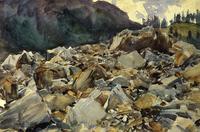
Purtud, Alpine Scene and Boulders
John Singer Sargent
A Murky Day
Joseph DeCamp
Study of Rocks
Claude Monet
View near Bettws-y-Coed
David Cox
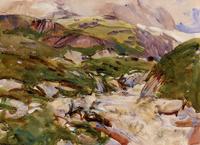
The Simplon
John Singer Sargent
Rochers Brutées
Theodore Robinson
Maine Cliffs
Winslow Homer
Crozant, les Monts Sedelle, matin
Armand Guillaumin
High mountains with chamoises
Arnold Böcklin
Grazing in the Roman countryside
Aurelio Tiratelli
Glacier Streams
John Singer Sargent
Landscape
Michele Cammarano
Mountain slope. Crimea
Arkhyp Kuindzhi
The Moraine
John Singer Sargent
Mountain landscape
August Friedrich Schenck
Rocks in Sestri Levante
Vincenzo Cabianca
From the vicinity of Gurzuf
Ivan Shishkin
Mountain Landscape
Sirak Skitnik