Expert analysis of John Singer Sargent’s John Ridgely Carter
Style: Realism · Genre: portrait
Expert Analysis: John Ridgely Carter by John Singer Sargent
Style & Period Significance:
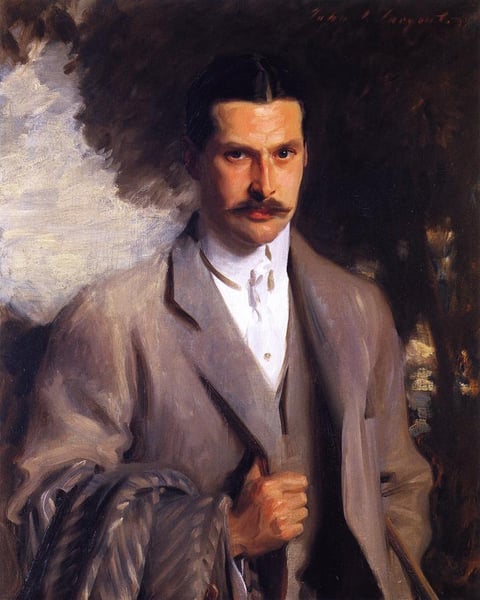
Sargent’s John Ridgely Carter epitomizes the late-19th-century Realist portrait tradition, elevated by the artist’s unmatched virtuosity. Though firmly grounded in realistic representation, Sargent transcends mere documentation through his fluid, confident brushwork and acute psychological insight. The portrait captures not only the sitter’s likeness but also his social standing and inner composure—hallmarks of Sargent’s contribution to the Gilded Age portrait genre.
Notable Features:
- Composition & Pose: Carter is presented in a dignified, three-quarter-length format, typical of official portraiture. The slight turn of the body and direct, calm gaze create an air of authority tempered by approachability.
- Lighting & Color: Sargent employs a restrained, naturalistic palette—deep blacks, warm flesh tones, and subtle highlights—that emphasizes both the sitter’s refined attire and the artist’s mastery of tonal modeling. The soft, directional light models the face and hands, drawing focus to Carter’s intelligent expression.
- Brushwork & Texture: Sargent’s characteristic loose, confident strokes are visible in the fabric of the coat and background, while the face is rendered with tighter precision. This contrast imbues the painting with a lively energy, avoiding the stiffness of many contemporary studio portraits.
Artistic & Cultural Significance:
As a portrait of John Ridgely Carter (a prominent Baltimore banker and philanthropist), the work exemplifies Sargent’s ability to convey both individual personality and the aspirational ideals of the American upper class. It stands as a testament to Realism’s power to merge objective observation with subjective artistry, securing Sargent’s legacy as the preeminent portraitist of his era.
Museum / Gallery
Visually similar
20 works with related composition and palette
Portrait noble
Paul Mathiopoulos
Albert Hayden Chatfield
Joseph DeCamp
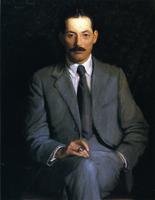
Edwin Arlington Robinson
Lilla Cabot Perry
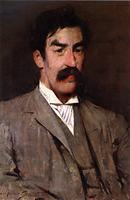
Professor Marshall-Hall
Tom Roberts
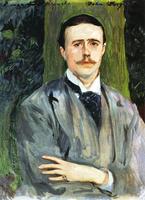
Portrait of Jacques-Emile Blanche
John Singer Sargent
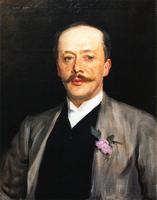
Charles Alexander Giron
John Singer Sargent
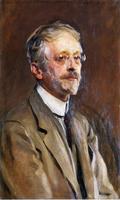
Charles Woodbury
John Singer Sargent
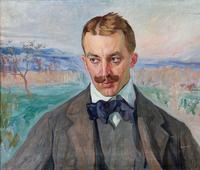
Portrait of Ivan Golubovsky
Oleksa Novakivskyi
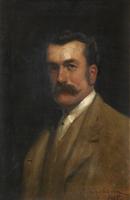
Self Portrait
Joseph Farquharson
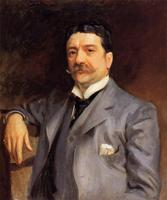
Portrait of Louis Alexander Fagan
John Singer Sargent
King George V
Solomon Joseph Solomon
Self Portrait
Giovanni Boldini
Ernest Lee Parker
Thomas Eakins
Portrait with birch trees
Simeon Velkov
Portrait of the Viennese Industrialist Raoul Leon von Wernburg
John Quincy Adams
Hugh Lane
John Singer Sargent
William Connal, Jr. Esq. of Solsgirth
Albert Joseph Moore
Frederic Francois Burghard
William Logsdail
Self-portrait
Vilhelm Hammershoi
Portrait of the painter Guido Grimani
Umberto Veruda