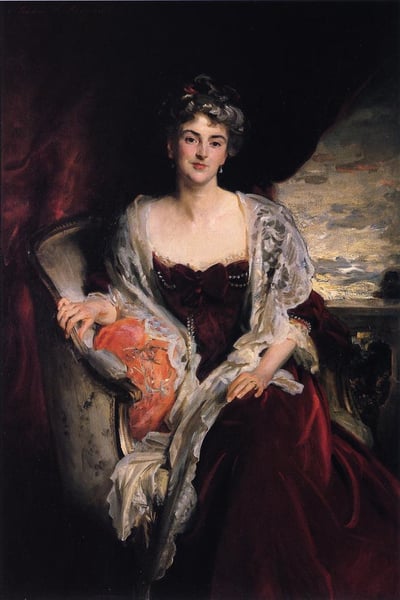
Mrs. Augustus Allusen (Osma Mary Dorothy Stanley)
Details
Expert analysis of John Singer Sargent’s Mrs. Augustus Allusen (Osma Mary Dorothy Stanley)
Style: Realism · Genre: portrait
John Singer Sargent’s Mrs. Augustus Allusen (Osma Mary Dorothy Stanley) is a masterful example of late-19th-century Realist portraiture that elevates the genre beyond mere likeness into a study of poise, social identity, and painterly virtuosity. Painted in the 1890s, a period when Sargent was at the height of his fame as a chronicler of Edwardian high society, the work demonstrates his unparalleled ability to blend meticulous naturalism with a fluid, almost impressionistic handling of fabric and light.
Stylistically, Sargent’s Realism here is not the stiff, photographic literalism of earlier generations; instead, it is a breathing, psychological realism that captures the sitter’s inner composure and external elegance. The portrait’s significance lies in how it balances the conventions of formal portraiture—the erect posture, the direct yet softened gaze, the sumptuous attire—with a sense of immediate presence. The handling of the black silk gown is particularly telling: Sargent uses bold, sweeping brushstrokes to suggest the sheen and weight of the fabric, while the face and hands are rendered with crisp, delicate precision. This contrast creates a dynamic tension between the perishable material world and the timeless character of the sitter.
Within Sargent’s oeuvre, this portrait is significant for its subdued intimacy in an era often marked by opulence. Unlike some of his more theatrical commissions (e.g., Madame X), here he focuses on the sitter’s quiet authority. Osma Mary Dorothy Stanley, wife of Lieutenant-Colonel Augustus Allusen, is presented as a woman of cultivated grace—her dark dress and subtle jewelry against a stark background emphasize her personality over her costume. Sargent’s Realism thus serves not just to document her appearance but to reveal a psychological state: self-possessed, intelligent, slightly reserved.
In the broader context of Realist portraiture, the work exemplifies Sargent’s contribution to the genre: making the conventional feel effortlessly alive. He merges the academic tradition of precise draftsmanship with a modern sensitivity to light and atmosphere, ensuring that the sitter’s presence transcends the era. For students of art history, this painting demonstrates why Sargent remains the definitive portraitist of his age—he could ennoble a subject through sheer technical brilliance while never losing sight of the human truth at the center of the canvas.
Museum / Gallery
Visually similar
20 works with related composition and palette
Mrs. David Curtis Deforest (Julia Wooster)
Samuel Morse
Portrait of Lady Helen Vincent, Viscountess D'Abernon
John Singer Sargent
Mrs. Philip Leslie Agnew
John Singer Sargent
Portrait of E. Oliv
Konstantin Somov
Margaret, Countess of Blessington
Thomas Lawrence
Madame Thurneyssen
Pierre-Auguste Renoir

Portrait of a Lady with Her Lacework
Joseph Wright

Mrs. William Crowninshield Endicott Jr.
John Singer Sargent
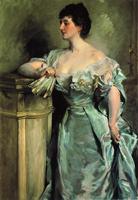
Lady Meysey Thompson
John Singer Sargent

Mrs Mary Lutwyche, Nee Thomas
George Romney

Sophia Petrovna Narishkina
Franz Xaver Winterhalter
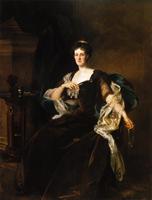
The Countess of Lathom
John Singer Sargent
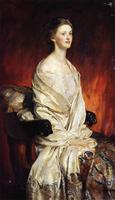
Sylvia Harrison
John Singer Sargent

Portrait of Russian opera singer Sandra Panaeva
Konstantin Makovsky

Mrs. Joseph E. Widener
John Singer Sargent

Mrs. Harold Harmsworth
John Singer Sargent

Alice Wernher born Alice Sedgwick Mankiewicz
John Singer Sargent

Portrait of Mlle de Gillespie - La Dame de Biarritz
Giovanni Boldini
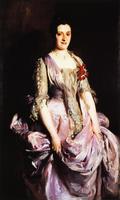
Mrs. Benjamin Kissam
John Singer Sargent

Caroline, Lady Holland
Joshua Reynolds