Description
Style: Realism · Genre: genre painting
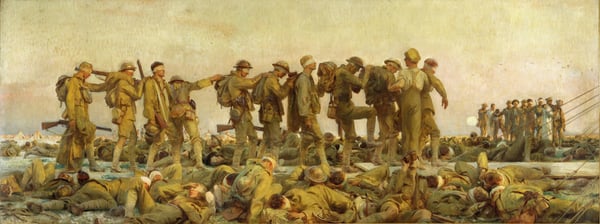
Gassed (1919) by John Singer Sargent depicts the aftermath of a mustard gas attack on the Western Front in August 1918. This is a unique painting in Sargent’s body of work, who is best known for fashionable portraits, such as Lady Agnew of Lochnaw (1892) and The Wyndham Sisters: Lady Elcho, Mrs. Adeane, and Mrs. Tennant (1899). In May 1918, Sargent was commissioned by the British government to create a large painting for the Hall of Remembrance for World War I. As an American painter, Sargent was asked to create a painting that represented the idea of Anglo-American cooperation. In 1918, Sargent traveled to France with fellow artist Henry Tonks to observe the troops on the Western Front, visiting the Guards Division at Bavincourt and the American Division at Ypres. Sargent struggled to find a suitable subject for the painting, he wanted to paint an epic showing masses of men, but could not find a scene that featured many British and American soldiers. Sargent considered several ideas before deciding to paint the aftermath of the mustard gas attack he witnessed while in France. He described the incident in a letter to biographer Evan Charteris as ‘one harrowing sight, a field full of gassed and blindfolded men’.
Gassed, a painting of a heroic scale (231x611 cm) shows several lines of wounded soldiers moving toward the dressing station. The scene is dark and tragic: the soldiers blinded by the gas have their eyes bandaged, they hold onto each other as medical orderlies assist them. All around them are bodies of wounded and dead piled on top of one another.
Sargent exposes the reality of war and the horrific impact of chemical weapons, his heroes are helpless and broken men, whose fates are a mystery - will they recover or see again, will they even survive? There is also activity in the background, biplanes flying through the sky and a group of soldiers playing football. Sargent’s painting examines the harsh realities of war: the poor conditions and equipment of the troops and the human suffering caused by the gas attack. The ongoing football match indicates how these horrors have become a constant presence that no longer interrupts the daily routine.
Sargent painting draws on the tradition of heroic paintings: the composition was inspired by the triptych The Battle of San Romano (ca.1435-1460) by Florentine painter Paolo Uccello. Some have also suggested that the central group of figures was inspired by Pieter Bruegel’s painting The Parable of the Blind (1568) and Auguste Rodin’s sculpture The Burghers of Calais (1884-1889). Gassed was first exhibited in 1919 at the Royal Academy in London, and it was voted picture of the year by the Royal Academy of Arts. Although the painting received high praise from Winston Churchill, it also had some notable critics. The novelists E.M. Forster and Virginia Woolf both criticized Gassed for being naively patriotic. Today the painting belongs to the collection of the Imperial War Museum in London.
Museum / Gallery
Visually similar
20 works with related composition and palette
2nd Oxfordshire and Buckinghamshire Light Infantry Fight the Prussian Guard at the Battle of Nonne Bosschen, 11 November 1914
William Barnes Wollen
The battle of the Somme
Richard Caton Woodville Jr.
Counterattack
Ivan Vladimirov
17th Lancers at the Battle of Modderfontein
Richard Caton Woodville Jr.
Coldstream Guards in France
William Barnes Wollen
The onset of chain
Ivan Vladimirov
The ambush
Alekos Kontopoulos
The Marines on the Fight at the Leningrad Front in January 1941
Veniamin Kremer
Reliefs at Dawn
C. R. W. Nevinson
"Fix Bayonets!" in the Trenches at Wagon Hill, Ladysmith, Natal
Richard Caton Woodville Jr.
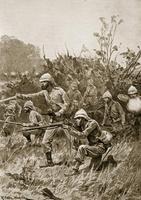
Advance of the British Force in the Ashanti Campaign
Richard Caton Woodville Jr.
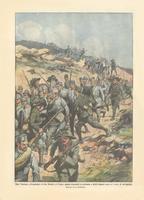
Enemies Surrounded By The Hundreds And Pushed Forward Like A Herd Of Game
Achille Beltrame
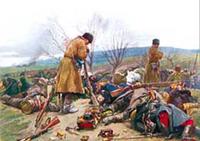
From the artist's diary, the War 1904-1905
Mykola Samokysh
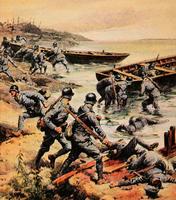
Austro-Hungarian troops trying to cross a river
Achille Beltrame
Smârdan Attack
Nicolae Grigorescu
Soldiers -
Theophile Steinlen
Pogrom of wine shop
Ivan Vladimirov
The last message
Fortunino Matania
Tarawa, 20 Nov 1943
Charles Waterhouse
The Last General Absolution of the Munster Fusiliers at Rue du Bois (27 November 1916)
Fortunino Matania