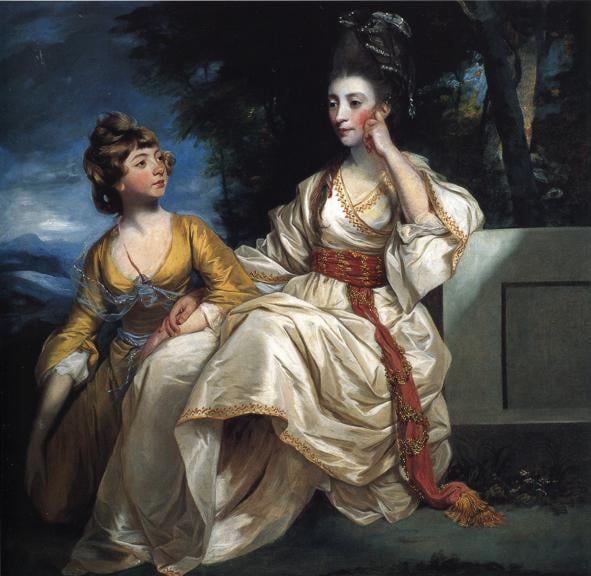
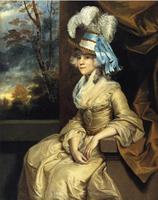
Mrs. Thrale and her Daughter Hester (Queeney)
Details
Expert analysis of Joshua Reynolds’s Mrs. Thrale and her Daughter Hester (Queeney)
Style: Rococo · Genre: portrait
Expert Analysis: "Mrs. Thrale and her Daughter Hester (Queeney)" by Joshua Reynolds
Significance within the Rococo Style and Portrait Genre
Joshua Reynolds’ Mrs. Thrale and her Daughter Hester (Queeney) exemplifies the Rococo portrait’s emphasis on intimate, graceful elegance and tender emotional connection. While Reynolds is often associated with the classical “Grand Manner,” this work adopts Rococo’s lighter, more playful sensibility—softened brushwork, a pastel-infused palette, and a focus on private, affectionate moments rather than formal state regalia.
Key Significance:
-
Emotional Intimacy and Maternal Bond – Unlike many formal 18th-century portraits that emphasize status or power, Reynolds captures a quiet, unguarded interaction between mother and child. The mother’s gentle gaze and the daughter’s trusting pose convey a sense of warmth and domestic affection characteristic of Rococo’s celebration of personal sentiment.
-
Psychological Depth through Rococo Sensibility – The painting subtly reveals the sitters’ personalities: Mrs. Thrale (Hester Lynch Thrale) was a noted literary hostess and intellectual; her daughter “Queeney” would later become a scholar. Reynolds softens their intellectual rigor with Rococo charm—the flowing drapery, soft lighting, and relaxed composition suggest that even learned women can embody the playful, graceful ideals of the style.
-
Transitional Hybridity – The work marks a significant moment in British portraiture: it blends Rococo’s decorative lightness (especially in the child’s rosy cheeks and the mother’s silken attire) with Reynolds’ emerging interest in psychological realism and classical stability. This hybridization anticipates later Neoclassical portraiture while retaining Rococo’s sensuous appeal.
-
Representation of Female Agency – By portraying a mother and daughter without male figures, Reynolds foregrounds female relationships and intellectual companionship. In the context of Rococo, which often depicted women as objects of desire, here the bond is one of mutual respect and nurturing—a subtle but significant redefinition of the genre.
In summary, Mrs. Thrale and her Daughter Hester (Queeney) is significant as a Rococo portrait that prioritizes authentic human connection over aristocratic display. It showcases Reynolds’ ability to harmonize Rococo elegance with nuanced characterization, elevating the portrait from mere likeness to a tender study of maternal love and female intellectual life in the 18th century.
Museum / Gallery
Visually similar
20 works with related composition and palette
Catherine, Lady Bampfylde
Joshua Reynolds
Mrs Beal Bonnell
George Romney
Portrait of Anne Loudon, Lady Henderson of Fordall
Angelica Kauffman

Jane, Countess of Harrington
Joshua Reynolds
Portrait of Zoe Victoire Talon Countess of Cayla with Her Children Ugoline and Ugolin
François Gérard
Susannah Hurt with Her Daughter Mary Anne
Joseph Wright
The Honourable Charlotte Clive (1762–1795)
George Romney
Dorothy, Countess of Lisburne
Joshua Reynolds
Anne, Countess of Albemarle, and Her Son
George Romney
The Frankland Sisters
John Hoppner
Portrait of Georgiana, Duchess of Devonshire
Joshua Reynolds
Mrs. Thomas Scott Jackson
George Romney
Sophonisba
Nikolaus Knüpfer
PORTRAIT OF A LADY THREE-QUARTER-LENGTH HOLDING FLOWERS
Jean-François de Troy
Female portrait. Perhaps Maria Alekseevna Gagarina, nee Volkonskaya
Joseph Kreutzinger
Portrait of Mrs. Abington, British Actress
Joshua Reynolds
Angelica and Medoro
Michael Stroj
Charlotte Bettesworth (c.1755–1841), Mrs John Sargent
George Romney
Lydia Elizabeth Hoare, Lady Acland, with Her Two Sons, Thomas, Later 11th Bt, and Arthur
Thomas Lawrence
Lady Taylor
Joshua Reynolds