Analisi esperta di Landscape with sitting farmer di Giovanni Domenico Tiepolo
Stile: Rococo · Genere: genre painting
Expert Analysis: "Landscape with sitting farmer" by Giovanni Domenico Tiepolo
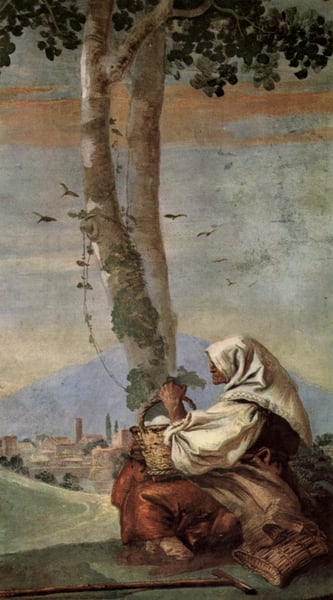
Giovanni Domenico Tiepolo (1727–1804) was a master of the Rococo period, and in Landscape with sitting farmer, he offers a compelling example of how Rococo decorative elegance could be fused with the humbler aims of genre painting. Rather than depicting mythological or aristocratic subjects, Tiepolo turns his attention to a quiet, everyday moment—a farmer seated within a pastoral landscape.
Significance within Rococo and Genre Painting
-
Elevation of the Rustic – While Rococo is often associated with playful, ornate scenes of courtly life or mythological allegory, Tiepolo here demonstrates a key undercurrent of the period: a growing interest in natural, informal subjects. The seated farmer is not a heroic peasant but a contemplative figure, rendered with a gentle, refined touch that softens his rustic reality into something idyllic. This aligns with the Rococo preference for charm and grace over drama or moral instruction.
-
Father–Son Dialogue – As the son of the great Giambattista Tiepolo, Domenico often worked alongside his father but developed his own voice in genre and landscape. Landscape with sitting farmer reflects this independent path: it is more intimate, less grandiose than typical Venetian ceiling frescoes, and it anticipates the later shift toward naturalistic, everyday scenes that would flourish in the 19th century.
-
Light and Atmosphere – Tiepolo’s Rococo roots are visible in the soft, luminous palette and the fluid, airy handling of the landscape. The sky and foliage are painted with a delicate, almost silvery touch, creating a serene mood that invites the viewer into a moment of quiet rural respite. This atmospheric quality was a hallmark of Venetian Rococo, and Tiepolo adapts it here to a subject of humble life, thereby bridging the decorative and the democratic.
In summary, Landscape with sitting farmer is significant because it exemplifies how Rococo conventions—graceful line, soft light, and decorative harmony—could be applied to genre painting without losing their elegance. It also marks Giovanni Domenico Tiepolo’s move toward a more personal, observational style, making him a transitional figure between the grand Baroque-Rococo of his father’s generation and the emerging taste for naturalism.
Visivamente simili
20 opere con composizione e palette affini
The Holy Family with John Elizabeth and the Infant John the Baptist
Nicolas Poussin
Giotto's childhood
Diogène Maillart
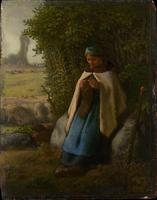
Shepherdess Seated on a Rock
Jean-Francois Millet
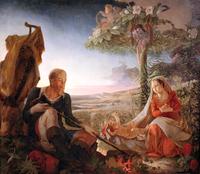
Rest on the Flight into Egypt
Philipp Otto Runge
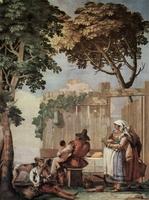
Peasant Family at Table, from the Room of Rustic Scenes, in the Foresteria (Guesthouse)
Giovanni Domenico Tiepolo
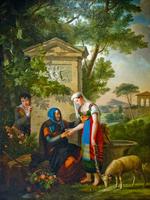
A Fortune Teller
Marie-Guillemine Benoist
Angelus
Anton Romako
Far from Home
George Harvey
Italian shepherd and girl
Franz Ludwig Catel
Laundresses
Cristiano Banti
Two Cowherds in a Meadow by the Water
Camille Corot
Repose
Rosa Bonheur
The rest near the wood
Jean Victor Schnetz
Neapolitan fisherman's daughter
Johann Heinrich Wilhelm Tischbein
Landscape with a Rainbow
Peter Paul Rubens
A Spring by the Sea
Jules Breton
Two Italian women
Ernst Meyer
Neapolitan family
Jean Victor Schnetz
Ruhe Auf Der Flucht
Philipp Otto Runge
Italian Peasants
Penry Williams