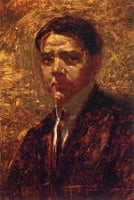
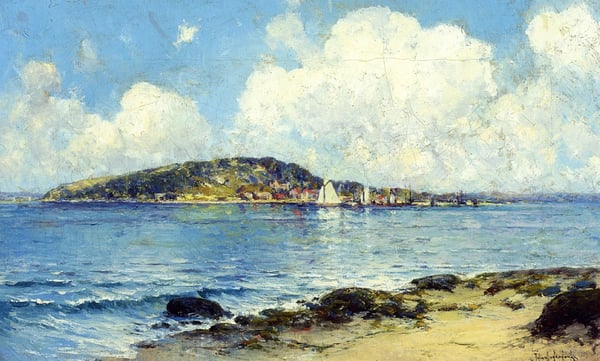
Coastal Scene
Expert analysis of Robert Julian Onderdonk’s Coastal Scene
Style: Impressionism · Genre: landscape
Expert Analysis of "Coastal Scene" by Robert Julian Onderdonk
Significance within Impressionism and American Landscape Painting
Robert Julian Onderdonk’s Coastal Scene exemplifies the artist’s role as a pioneering figure in American Impressionism, particularly in the context of the Texas Gulf Coast. While the painting’s precise date is not provided, it reflects the core tenets of the Impressionist movement: a focus on natural light, atmospheric effects, and loose, visible brushwork.
What Makes It Significant:
-
Regional Adaptation of Impressionism: Onderdonk is often celebrated as the “father of Texas painting.” In Coastal Scene, he applies the French Impressionist vocabulary—broken color, plein-air immediacy—to the distinctively flat, luminous landscape of the Texas coastline. This fusion marks a critical moment in the spread of Impressionism beyond its European and Northeastern American origins, demonstrating how the style could be reinterpreted to capture a region’s unique light and topography.
-
Atmospheric Sensitivity: The work likely emphasizes the hazy, humid quality of the coastal air, with subtle gradations of blue, green, and sandy tones. Onderdonk’s brushwork would have been alive with dabs of pure pigment, suggesting shimmering water and dappled foliage. This aligns with the Impressionist goal of recording the transient effects of weather and time of day—a hallmark that distinguishes his coastal scenes from more static, academic landscapes.
-
Contribution to American Impressionism: Onderdonk studied at the Art Students League in New York and under William Merritt Chase (a key figure in American Impressionism). His Coastal Scene bridges the refined tonalism of the East Coast school with the raw, expansive character of the American South. The painting thus serves as a vital link in the narrative of how Impressionism evolved into a distinctly American idiom, adapted to local environments rather than merely imitating French models.
-
Genre as Innovation: As a landscape, Coastal Scene prioritizes natural beauty over narrative or human figures. In the context of late 19th- and early 20th-century Texas, such a focus was innovative: it elevated the state’s coastal wilderness to a subject worthy of high art, challenging the prevailing view of the region as merely frontier or pastoral. Onderdonk’s coastal works helped establish a visual identity for Texas in the national art scene.
In sum, Coastal Scene is significant not only for its technical execution within Impressionism—its luminous palette, fluid brushwork, and capturing of fleeting natural light—but also for its role in expanding the geographical and thematic boundaries of the movement. Onderdonk proved that Impressionism could thrive in the sun-soaked, breezy shores of the Gulf, making his coastal landscapes enduring contributions to American art history.
Visually similar
20 works with related composition and palette
On Long Island Sound near Shelter Island
Robert Julian Onderdonk
Evening at the Sea
Maxime Maufra
Low Tide at Douarnenez
Maxime Maufra
The Coast at Fort Penthievre, Quiberon Peninsula
Maxime Maufra
Kystlandskap med folkeliv
Morten Muller
Fishing Boats. St. Ives.
Stanley Spencer
Bay in Livorno. sunset
Nikolai Ge
The Coastline in Brittany
Maxime Maufra
Blue and Silver Trouville
James McNeill Whistler
Plougastel, the Ferry Passage
Eugene Boudin
Near Saint Malo
Henri Martin
The Coastline at Plougastel
Eugene Boudin
The Shore. Cloudy Day
Fyodor Vasilyev
Sea Coast in Normandy
Gustave Courbet
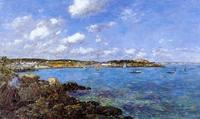
The Bay of Douarnenez
Eugene Boudin
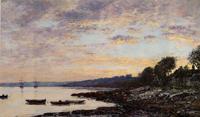
Brest, the Harbor
Eugene Boudin
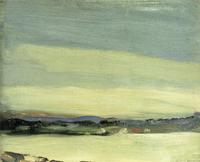
Leunkin Bay, June
Robert Henri
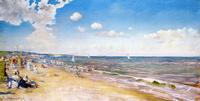
The Beach at Zandvoort
William Merritt Chase
Seascape at Arcachon (Arcachon, beautiful weather)
Edouard Manet
Evening, Morgat Beach
Maxime Maufra