Robert Julian Onderdonk sanatçısının Landscape with Cattle eseri hakkında uzman analizi
Tarz: Impressionism · Tür: animal painting
Expert Analysis: "Landscape with Cattle" by Robert Julian Onderdonk
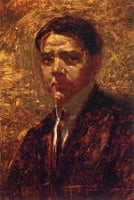
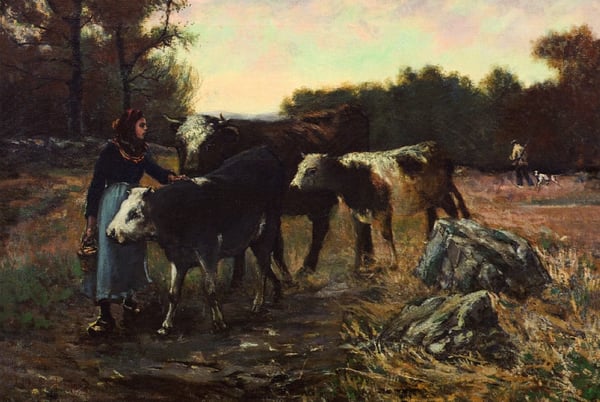
This work is a prime example of American Impressionism adapted to the Texan landscape. While the facts supplied are minimal—the artist, style, and genre—the significance of the piece emerges from the intersection of these elements.
Significance within Impressionism:
Onderdonk (1852–1917) is celebrated as the "father of Texas painting" and a leading figure in the American Impressionist movement. Unlike his contemporaries who focused on northeastern or European scenes, Onderdonk brought Impressionist techniques—broken color, loose brushwork, and an emphasis on fleeting atmospheric effects—to the harsh, bright light of the American Southwest. In Landscape with Cattle, this manifests in how he captures the shimmering heat and dust-laden air of a Texas prairie, using dappled touches of green, gold, and umber to suggest foliage and grazing animals rather than delineating them precisely. The cattle, rendered as soft, almost abstract shapes, become part of the luminous whole—a hallmark of Impressionist unity between subject and environment.
Significance within the Genre of Animal Painting:
Although animal painting often places creatures as heroic or sentimental focal points, Onderdonk subverts this tradition. His cattle are not idealized or singularly highlighted; they are integrated into the landscape as natural, almost incidental elements of rural life. This reflects a shift in animal painting toward realism and environmental context, moving away from the romanticized animal portraits of the 19th century. Instead, the animals serve as anchors that ground the Impressionist light show in everyday agricultural reality—a quiet dignity that aligns with American Regionalist sensibilities.
Cultural and Artistic Significance:
Onderdonk’s work is significant for bridging European Impressionist technique with American regional identity. Landscape with Cattle exemplifies his ability to make the Texas Hill Country—often dismissed as un-picturesque by East Coast standards—worthy of the same painterly treatment as Monet’s haystacks. The cattle, a symbol of the state’s ranching heritage, subtly assert that an authentic American Impressionism need not look to France or New England for beauty; it could find grandeur in the simple, sun-scorched pastures of the South.
Conclusion:
This painting is significant not for dramatic innovation, but for its quiet mastery of synthesis: marrying a European art movement to a distinctly American place and its working animals. It stands as a testament to Onderdonk’s role in expanding Impressionism’s geographic and thematic boundaries, making the Texas landscape—and its cattle—a legitimate subject for high art.
Görsel olarak benzer
İlişkili kompozisyon ve renk paletine sahip 20 eser
Cows and washerwomen near a brook
Rudolf Koller
On the Lookout
Julien Dupré
Driving Home the Cows
Edward Mitchell Bannister
Returning From Pasture
Constant Troyon
Pastoral scene with a cowherdess
Anthonie Jacobus van Wijngaerdt
Noonday Rest
Rosa Bonheur
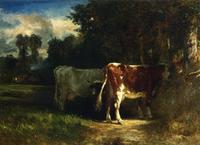
Cows in a Landscape
Constant Troyon
Cows at the Watering
Constant Troyon
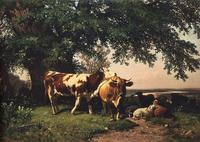
Herd under the trees
Ivan Shishkin
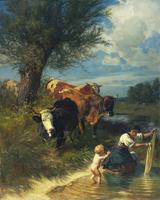
Cows and washerwomen near a brook
Rudolf Koller
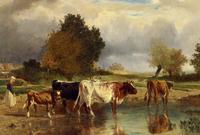
Calf cows at the marl
Constant Troyon
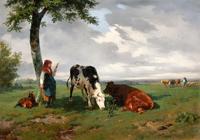
A Shepherdess with a Goat and Two Cows in a Meadow
Rosa Bonheur
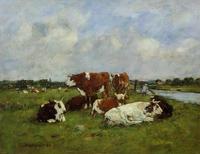
Pasturage on the Banks of the Touques
Eugene Boudin
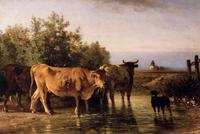
The Ford
Constant Troyon
Shepherd with cattle by the water
Johann Heinrich Roos
Cows in Pasture
James McDougal Hart
Freshness of Morning
Algernon Talmage
Rinder am Wasser
Johann Daniel Holz
Return of the Herd
Constant Troyon
Pasture at Deauville
Eugene Boudin