
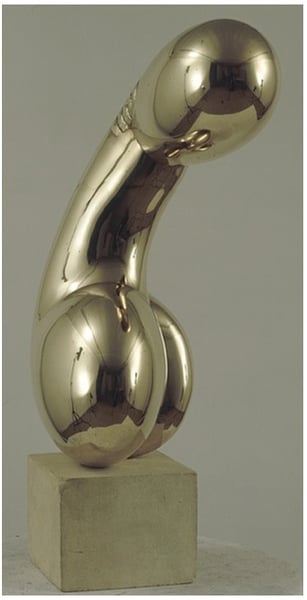
Expert analysis of Constantin Brâncuși’s Princess X
Style: Dada · Genre: sculpture
Analysis of "Princess X" (Constantin Brâncuși)
Although Brâncuși is primarily celebrated as a pioneer of modernist abstraction—specifically the reduction of form to its purest essence—the work has also been historically interpreted through a Dada lens due to its provocative, anti-conventional impact on the art world of the early 20th century. In this context, "Princess X" becomes significant as a sculptural object that weaponizes ambiguity and absurdity, two core Dada strategies for challenging bourgeois taste and traditional aesthetic hierarchies.
Formal Reduction and Subversive Ambiguity
The sculpture is a polished bronze abstract of an elongated female head, tilted back as if in ecstasy or defiance. Its gleaming, streamlined surface eliminates all anatomical detail, leaving only a smooth, swooping silhouette. Yet the very simplicity of that silhouette—the bulbous crown merging into a slender, phallic neck—creates an unmistakable sexual double-entendre. When exhibited at the 1920 Salon des Indépendants, the piece was removed from public display after being deemed obscene; critics and viewers saw not a princess but a phallus. This scandal perfectly exemplifies Dada’s love of the readymade irony: a refined, polished object of high-art craftsmanship becomes a vehicle for low, shocking humor. Brâncuși claimed he intended a portrait of Princess Marie Bonaparte (a descendant of Napoleon and a follower of Freud), yet the work’s refusal to clearly denote its subject aligns with Dada’s rejection of fixed meaning.
Significance within the Dada Moment
While Brâncuși was not a card-carrying Dadaist, "Princess X" resonates with the movement’s core tactics:
- Defamiliarization: A familiar portrait convention is twisted into an abstract geometry that feels almost obscene.
- Provocation as Critique: The uproar over the work’s “indecency” exposed the hypocrisy of a society that accepted more explicit classical nudes but recoiled at a modern, suggestive shape.
- Material as Irony: The high-polish bronze—a material traditionally associated with heroic, dignified monuments—here mocks the very idea of nobility and portraiture. The “princess” is reduced to a gleaming, impersonal, and blatantly sexualized contour, undermining the gravitas of aristocratic representation.
Legacy
"Princess X" endures as a landmark work that bridges sculptural modernism and Dada’s anti-art sensibility. Its power lies in its refusal to resolve: Is it a beautiful study of pure form? A vulgar joke? A Freudian slip cast in metal? The inability to answer definitively is precisely what makes it a Dada object avant la lettre. In turning a princess into a polished totem of ambiguous desire, Brâncuși dismantled the boundaries between high art, satire, and scandal—a gesture that would profoundly influence Surrealist and post-Dada sculpture.
Visually similar
20 works with related composition and palette

Janus Fleuri
Louise Bourgeois

Globular
Noguchi Isamu

Princess X
Constantin Brâncuși

Pink Jizo
Noguchi Isamu

Le signal
Leon Arthur Tutundjian

MACHINE MOTORISÉE
Alexander Calder

The Doll
Hans Bellmer
Human Concretion
Jean Arp
A girl
Louise Bourgeois

Bird in Space (L'Oiseau dans l'espace)
Constantin Brâncuși
L'Arbre
Agustin Cardenas

Cloud Shepherd
Jean Arp

Human Concretion
Jean Arp

Seated Female Nude (Black Torso)
Olexandr Archipenko
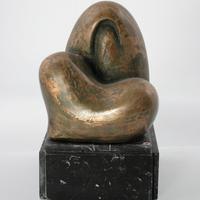
Maternidad
Kalato

The parting of Hector and Andromache #1
Alexander Roitburd

Growth
Jean Arp

Mademoiselle Pogany II
Constantin Brâncuși

Venus
MAUREEN QUIN

Pimpin' Ain't Easy
Chris Ofili