
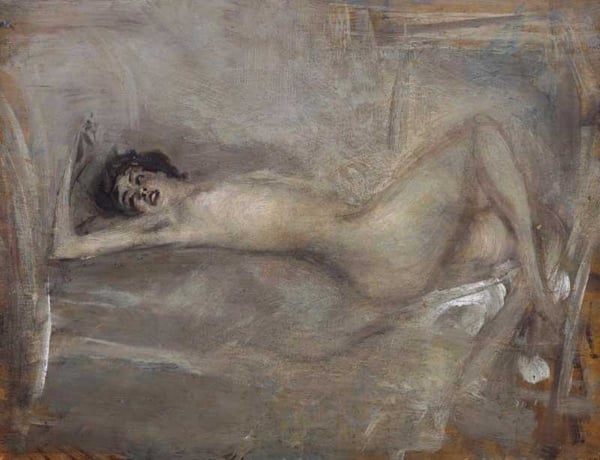
Analisi esperta di Symphony in Gray di Giovanni Boldini
Stile: Impressionism, Kitsch · Genere: nude painting (nu)
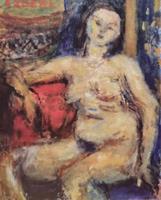
Giovanni Boldini’s Symphony in Gray stands at a fascinating crossroads: it marries the painterly freedom of Impressionism with the self-aware polish of what would later be termed Kitsch, all within the traditional genre of the nude. This combination makes the work significant as a transitional piece that both honors and subverts the avant-garde ideals of its time.
Significance within Impressionism
Boldini, though affiliated with the Impressionists in his use of visible, rapid brushstrokes and a fascination with modern life, diverged from their core concerns. Where Monet or Renoir sought to capture the fleeting effects of natural light, Boldini here applies Impressionist technique to a studio-bound, highly composed nude. The “Symphony” in the title suggests a tonal experiment—a deliberate reduction of color to a range of grays, silvers, and soft whites. This approach echoes Whistler’s “Nocturnes” and “Arrangements,” aligning Boldini with the Aesthetic Movement’s emphasis on mood and harmony over narrative. Yet unlike Whistler’s austere elegance, Boldini’s brushwork is more sensual and energetic: flickering highlights dance across the model’s skin, and the background dissolves into a haze of atmospheric strokes. This union of Impressionist spontaneity with a controlled, almost monochrome palette demonstrates how the movement’s methods could be adapted for interior, decorative purposes.
Significance within the Kitsch Aesthetic
Boldini’s work has often been labeled “Kitsch” not as a dismissal, but as a recognition of its deliberate appeal to luxury, sophistication, and immediate visual pleasure. In Symphony in Gray, the Kitsch quality emerges from the painting’s hyper-refinement. The nude is idealized—her pose is languid, her features softened, and her flesh rendered with a porcelain smoothness that contrasts with the sketchy surroundings. There is no raw immediacy, no awkwardness of the real body; instead, the figure is a polished fantasy. The grayscale palette itself becomes a sign of elegance, a conscious effort to elevate the nude into a decorative object of taste. Boldini, who painted the elite of Belle Époque society, understood that his audience craved images that were both sensuous and safe—art that flattered the eye without challenging social or artistic norms. In this, Symphony in Gray prefigures the 20th-century commercial glamour of pin-up and fashion illustration, while retaining the cachet of Impressionist pedigree.
Conclusion
The work’s significance lies in its synthesis of opposing impulses: the radical, unfinished look of Impressionist technique is harnessed to create a perfectly finished, marketable image of beauty. Boldini proves that the avant-garde brushwork of the 1870s could be domesticated for the drawing rooms of the wealthy, and that “Kitsch” need not be a pejorative when it is executed with such virtuosic control. Symphony in Gray remains a compelling example of how artistic innovation can be repurposed for sheer, unabashed visual pleasure.
Visivamente simili
20 opere con composizione e palette affini
Volupté
Antonio de La Gándara
Nude
Bela Czobel
Reclining Nude Figure of a Girl
Thomas Dewing

Nude with Green Slippers
Émilie Charmy
Félakt
Bela Czobel
Laid Back Nude
Iosif Iser
Reclining Nude
Edgar Degas

Nude on the Grass
Pierre-Auguste Renoir
Nude
Bela Czobel
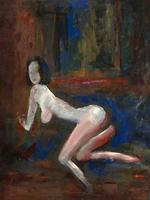
Nude
Valentin Khrushch
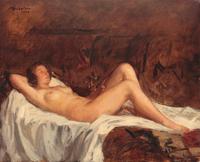
Reverie
Ipolit Strambu

Nude sitting
Nicolae Vermont

On the Sofa
Károly Lotz
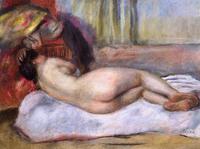
Sleeping Nude with Hat (Repose)
Pierre-Auguste Renoir
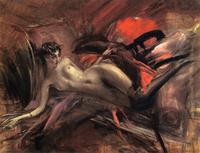
Reclining Nude
Giovanni Boldini
Reclining Nude
Paul Cezanne
Woman At the Chest
Pierre-Auguste Renoir
Reclining Nude (Fernande)
Pablo Picasso
Reclining Nude
Arthur Beecher Carles
Seated Nude
Bela Czobel