
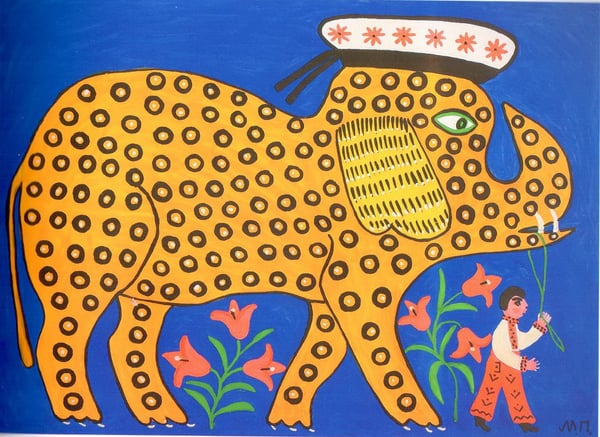
The Little Elephant Who Wanted to Be a Sailor
Dettagli
Analisi esperta di The Little Elephant Who Wanted to Be a Sailor di Maria Primachenko
Stile: Naïve Art (Primitivism) · Genere: symbolic painting
Expert Analysis of "The Little Elephant Who Wanted to Be a Sailor" by Maria Primachenko
Within the realm of Naïve Art (Primitivism), Maria Primachenko stands as a singular voice, blending Ukrainian folk traditions with a deeply personal, symbolic vision. Her painting "The Little Elephant Who Wanted to Be a Sailor" exemplifies the genre’s core strengths: unmediated emotional expression, vibrant ornamentation, and a defiantly non-academic approach to form and perspective.
Significance in Naïve Art and Folk Modernism
Primachenko’s work bridges rural folk culture and modernist primitivism, a movement that sought authenticity outside Western artistic conventions. This painting, though whimsical, carries symbolic weight: the elephant—an exotic animal wholly outside the artist’s Ukrainian village experience—represents the universal human desire for adventure and self-transformation. The choice of a sailor’s ambition further roots the fantasy in a real-world longing for freedom, typical of Primachenko’s allegorically charged menagerie.
Formal and Symbolic Characteristics
True to Naïve Art, the composition rejects academic perspective; the elephant is flattened against a richly patterned, two-dimensional ground. Primachenko’s hallmark use of bold, contrasting colors and intricate floral or geometric motifs infuses the scene with a celebratory, almost ritualistic energy. The elephant’s oversized ears and exaggerated trunk are rendered with a childlike simplicity, yet the careful detailing of its sailor hat and uniform signals the artist’s meticulous symbolic storytelling. The work is not merely decorative—it is a meditation on aspiration, with the little elephant standing as an everyman figure, undeterred by the absurdity of its dream.
Legacy
This painting is significant because it encapsulates Primachenko’s unique contribution to Primitivism: she did not imitate folk art but reinvented it, using its vocabulary to explore modern themes of identity and longing. In a period when Soviet authorities often demanded socialist realism, Primachenko’s vibrant fantasies asserted the power of personal, ungoverned imagination. "The Little Elephant Who Wanted to Be a Sailor" remains a testament to Naïve Art’s ability to speak profound truths through seemingly simple, joyful images.
Visivamente simili
20 opere con composizione e palette affini
Elephant
Maria Primachenko
Green Elephant
Maria Primachenko
Big Jumbo
William Hawkins
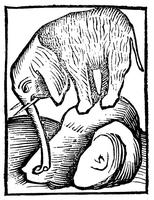
Elephant in Hortus sanitatis
Martin Schongauer

Elephant
Abraham Palatnik
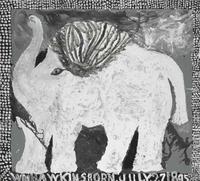
White Elephant
William Hawkins
Juvenile Elephant
Walter Battiss
Elefante
Sergio Hernández
Elephant
Maurice Prendergast
Black Beast
Maria Primachenko
Untitled
Oleg Holosiy
Elephant is Killing a Lion in Funny Way in 1975
John Muafangejo
Exlibris G. D.
Oleksandr Aksinin
Untitled
Alevtyna Kakhidze
Je Fume Le Nil
Leonetto Cappiello
Long-Necked and Itching
Maria Primachenko
The Elephant Enticement
Twins Seven Seven
Horse blanket
Sue Coe
Elefant
Martin Schongauer
Another Beast Has Run Into Flowers
Maria Primachenko