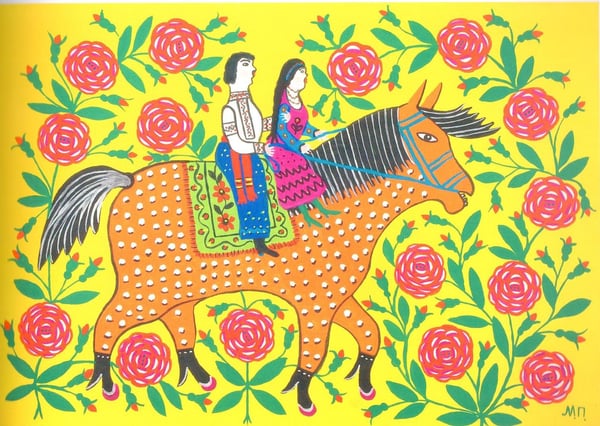
Maiden and Cossack Enjoying a Ride on Horseback
Dettagli
Analisi esperta di Maiden and Cossack Enjoying a Ride on Horseback di Maria Primachenko
Stile: Naïve Art (Primitivism) · Genere: genre painting
Expert Analysis: "Maiden and Cossack Enjoying a Ride on Horseback" by Maria Primachenko
Maria Primachenko’s Maiden and Cossack Enjoying a Ride on Horseback is a vibrant exemplar of Naïve Art (Primitivism), a style defined by its deliberate rejection of academic conventions in favor of childlike directness, bold color, and symbolic storytelling. Within this tradition, Primachenko stands as a singular voice, merging the visual language of Ukrainian folk ornament with a deeply personal, almost mythic imagination.
Significance within Naïve Art and Its Period:
-
Folk Roots Meets Modernist Sensibility: Primachenko’s work occupies a unique intersection between vernacular folk painting and the international Primitivist movement (as seen in artists like Henri Rousseau or Niko Pirosmani). Unlike many Western naïve artists, she was a self-taught peasant artist who drew directly from the ritualistic, decorative traditions of Ukrainian embroidery, woodcarving, and mural painting. In this painting, the horse is not anatomically realistic but rather a stylized, heraldic creature—its mane and tail become flowing ribbons of pattern, echoing the “tree of life” motifs common in Ukrainian folk art.
-
Genre Painting as Cosmic Narrative: Though classed as a genre painting (depicting everyday life), Primachenko elevates a simple ride into a timeless, magical event. The maiden and Cossack are not individualized portraits but archetypes—the Cossack symbolizing freedom and martial valor, the maiden representing fertility and the land. Their joyful movement across the canvas is less a specific anecdote than a universal celebration of harmony between human and nature, male and female, earth and sky. This aligns with Primachenko’s broader oeuvre, where animals and humans coexist in fantastical, often surreal landscapes.
-
Color and Compositional Authority: Naïve art is often characterized by its unfettered use of color, but Primachenko’s palette is notably sophisticated. She employs strong primaries—deep reds, intense blues, sunny yellows—against flat, unmodulated backgrounds. In this piece, the horse’s bright white or red and the maiden’s floral-patterned dress create a rhythmic visual dance. The composition is deliberately front-facing and symmetrical, a hallmark of folk iconography that gives the scene a ceremonial weight. There is no perspective depth; the figures exist in a floating, decorative plane, inviting the viewer into a world untroubled by naturalistic rules.
-
Cultural and Political Resonance: Primachenko worked through some of Ukraine’s most turbulent periods—Stalinism, World War II, and Soviet rule. Her naïve style offered a form of quiet resistance, preserving Ukrainian cultural identity through folk symbology when such expressions were often suppressed. Maiden and Cossack can be read as a celebration of Cossack heritage, a symbol of Ukrainian independence and joy, rendered in a deceptively simple manner that allowed it to escape state censorship. It is significant because it demonstrates how naïve art can serve as a vehicle for national memory and pride.
-
Legacy as a Naïve Master: Primachenko’s work has been recognized by UNESCO and displayed internationally. Her ability to fuse the naïve aesthetic with profound narrative depth—making the everyday appear enchanted—distinguishes her from other primitivists. This painting encapsulates her genius: a scene that feels both ancient and freshly invented, painted with the unfiltered vigor that defines the best of naïve art. It reminds us that primitivism is not about lack of skill, but about channeling a different kind of knowledge—one rooted in folklore, intuition, and the joy of unmediated creation.
Visivamente simili
20 opere con composizione e palette affini
Autumn is riding on a horseback
Maria Primachenko
Medieval Promenade
Eyvind Earle
Ola Man and Old Woman Carry a Turnip
Maria Primachenko
Halia and cossack
Maria Primachenko
Female Rider
Ernst Ludwig Kirchner
Medieval Promenade
Eyvind Earle
Flight into Egypt
Clementine Hunter
Rider On Horseback
William Hawkins
Anna Margit, Mese 1964
Anna Margit
Change of Residence
Paul Gauguin
By Beloved Plows the Field
Maria Primachenko
The Year's at the Spring
Harry Clarke
Horse Hair
David Michael Hinnebusch
Lamd Has Harnesed a Wolf
Maria Primachenko
The Rider
Maurice Prendergast
Atilla Commander, Statesman, Ruler of Huns, Scythians
Ivan-Valentyn Zadorozhny
Longing
Bela Kadar
Illustration from Arabella and Araminta Stories
Ethel Reed
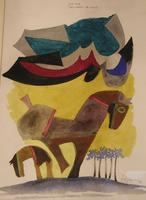
Hai-Seen-Hai-Noon
M.F. Husain
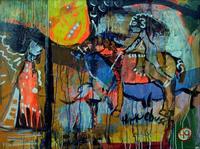
Sun Ra
David Michael Hinnebusch