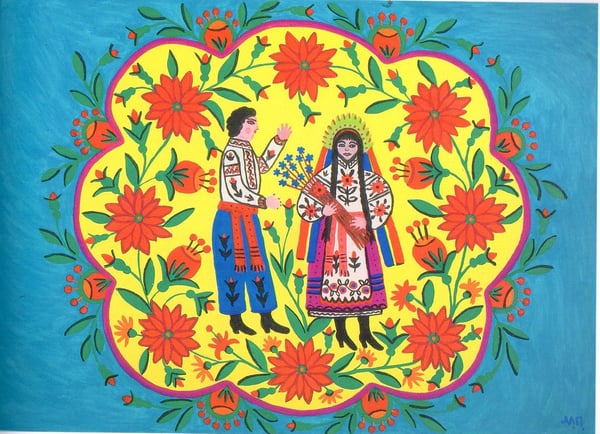
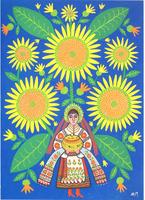
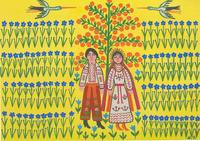
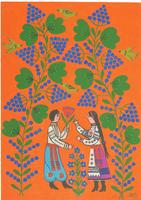
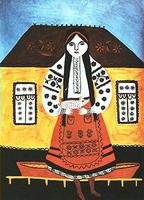
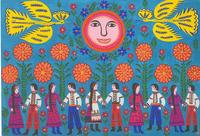
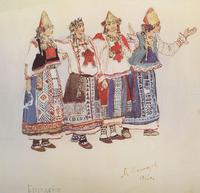
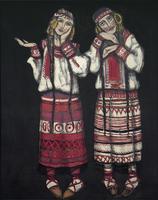
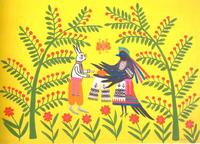
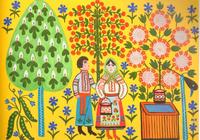
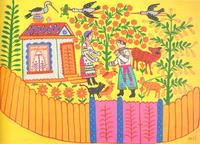
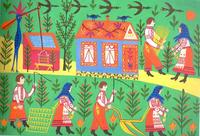
Maria Primachenko’s Flax Blooms and a Cossack Goes to a Girl (c. 1960s–1980s) exemplifies the vibrant, symbolic language of Ukrainian Naïve Art, a movement rooted in folk tradition and untutored expression. Primachenko, a self-taught artist recognized by UNESCO, transformed genre painting into a fantastical realm where everyday life merges with myth. In this work, the “Cossack” – a historic symbol of Ukrainian freedom and romance – strides toward a girl, but the true focus is the surrounding world: flax blooms burst in unnatural, radiant forms, painted with bold, unmodulated colors and flat, decorative patterns. The composition lacks perspective, compressing space into a tapestry-like surface, while the figures are stylized, their gestures simplified yet charged with narrative intent. What makes this painting significant is Primachenko’s ability to fuse personal vision with collective identity: the flax, a plant tied to Ukrainian textile traditions, becomes a magical landscape, and the Cossack’s journey is both a folk tale and a metaphor for life’s cyclical joys. Her work helped elevate Naïve Art from a marginalized craft to a recognized form of modern art, influencing generations by proving that raw, intuitive creativity can carry profound cultural and emotional weight.