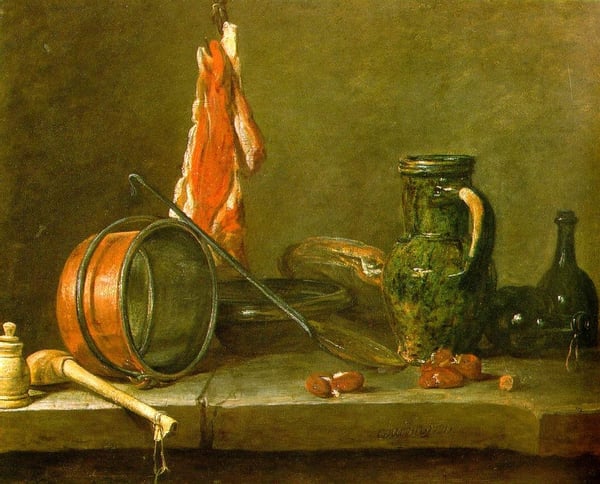
Expertenanalyse zu Jean-Baptiste-Simeon Chardins A Lean Diet with Cooking Utensils
Stil: Rococo · Genre: still life
Expert Analysis: "A Lean Diet with Cooking Utensils" by Jean-Baptiste-Siméon Chardin
In the context of Rococo art—a style often associated with playful aristocratic frivolity, pastel colors, and ornate sensuality—Chardin’s still life stands as a quiet, radical counterpoint. "A Lean Diet with Cooking Utensils" exemplifies the artist’s unique ability to elevate everyday domestic objects into subjects of profound visual and emotional significance.
Key Significance within Rococo and the Still Life Genre:
-
Radical Subject Matter and "Lowly" Realism:
While Rococo painters like Boucher and Fragonard delighted in mythological idylls or amorous courtship scenes, Chardin turned his attention to the simplest of kitchen provisions: a modest meal of bread, a bottle, a few vegetables, and worn cooking utensils. The "lean diet" of the title is literal—these are not lavish banquets but the quotidian staples of ordinary life. In doing so, Chardin brought a sense of dignity and quiet contemplation to objects that were usually ignored or deemed unworthy of high art, aligning him with the emerging bourgeois sensibility of the mid-18th century. -
Mastery of Texture and Light:
Chardin’s brushwork is deceptively simple. He builds forms with thick, layered impasto, creating a palpable sense of substance—the rough crust of bread, the reflective gleam of copper pots, the soft matte finish of earthenware. The light is soft and diffuse, often coming from a single source, casting gentle shadows that unify the composition. This handling of light was groundbreaking; it did not just illuminate but seemed to emanate from the objects themselves, giving them a life and presence that transcends their humble nature. -
A Moral and Aesthetic Statement:
In an age of opulence, "A Lean Diet" can be read as a subtle moral statement—a celebration of simplicity, thrift, and the virtue of modest living. Chardin’s still lifes were admired by Denis Diderot, who praised their "truth" and the way they compelled the viewer to look slowly and thoughtfully. This introspective, almost meditative quality was unusual for Rococo, which often aimed at immediate visual pleasure. Chardin instead invites us to find beauty in the ordinary, making him a forerunner of later realist traditions. -
Compositional Harmony:
The arrangement of utensils—ladles, a mortar, a skillet—is not haphazard. Chardin carefully balances vertical and horizontal lines, creating a stable, pyramidal structure that echoes classical still-life traditions. Yet the slight asymmetry and the soft, naturalistic arrangement feel unposed, as if the viewer has just stepped into a quiet kitchen corner. This blend of formal order and spontaneous naturalism is the hallmark of his genius.
Conclusion:
"A Lean Diet with Cooking Utensils" is significant because it redefines what Rococo art can be—that is, intimate, earnest, and deeply human rather than decorative or escapist. Chardin’s ability to transform a frugal meal into a profound meditation on material existence and light is the very reason he is considered one of the greatest still-life painters in European art, influencing generations from the Realists to the modern era.
Museum / Gallery
Visuell ähnlich
20 Werke mit ähnlicher Komposition und Farbpalette
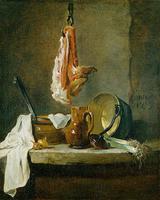
Still Life with a Rib of Beef
Jean-Baptiste-Simeon Chardin
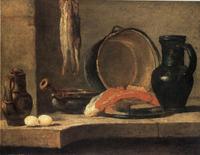
Still Life of Kitchen Utensils
Jean-Baptiste-Simeon Chardin
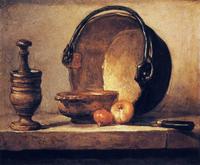
Still Life with Pestle, Bowl, Copper Cauldron, Onions and a Knife
Jean-Baptiste-Simeon Chardin
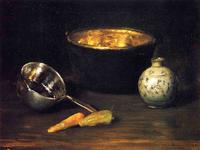
Still Life with Pepper and Carrot
William Merritt Chase
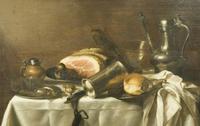
Still Life
Pieter Claesz
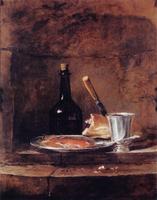
The Leftovers of a Lunch, also called the Silver Goblet
Jean-Baptiste-Simeon Chardin
Stillleben Mit Tischgedeck
Juan van der Hamen
Carnera
Nicola Samorì
Still Life with Brass
Maurice Louis Monnot
BODEGÓN MIT SCHINKEN, HAHN UND KUPFERGESCHIRR
Luis Meléndez
Kätzchen in Scheune
Cornelis Saftleven
Still Life with Churn
Paul Serusier
Peasant Interior with Woman at a Well
Willem Kalf
Still Life
Fanny Churberg
Artist's atelier
Edouard Manet
La Deserte (after Jan Davidsz, De Heem)
Henri Matisse
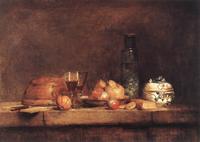
Still Life with Jar of Olives
Jean-Baptiste-Simeon Chardin
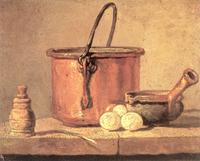
Still Life of Cooking Utensils, Cauldron, Casserole and Eggs
Jean-Baptiste-Simeon Chardin
Still Life with Earthen Pot
Henri Matisse
Still life
Balthus