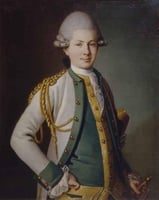
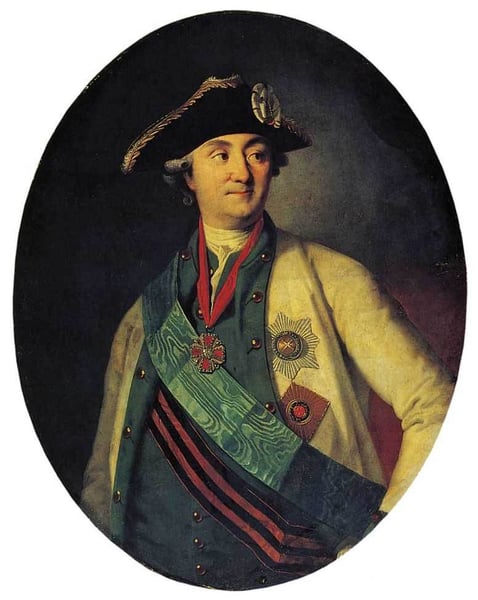
Analisi esperta di Portrait of Count Orlov-Chesmensky di Carl-Ludwig Johann Christineck
Stile: Rococo · Genere: portrait
Expert Analysis of "Portrait of Count Orlov-Chesmensky" by Carl-Ludwig Johann Christineck
This work stands as a telling example of Rococo portraiture’s ability to merge aristocratic elegance with individual character, while also reflecting the cross-cultural artistic currents of 18th-century Europe. Painted by the German-born artist Carl-Ludwig Johann Christineck, who worked extensively in Russia, the portrait captures Count Alexei Orlov-Chesmensky—a key figure in Catherine the Great’s court and a celebrated naval commander. Within the Rococo style, which prized grace, soft palettes, and decorative charm, Christineck’s treatment of Orlov is significant for balancing the era’s typical lightness with a subject of formidable military and political stature.
The portrait’s significance lies in its synthesis of Rococo’s refined aesthetic with the rising Russian taste for Western European sophistication. Orlov is likely depicted with the hallmark Rococo features: a gentle, flattering gaze, elegant drapery, and a subtle play of pastel tones that soften his martial identity. Yet unlike many Rococo portraits that indulge in pure frivolity or mythological allegory, Christineck’s work retains a sense of restrained power—Orlov’s direct expression and posture suggest the authority of a man who helped orchestrate the coup that brought Catherine to power and later commanded the Russian fleet at the Battle of Chesma (whence his title). This duality makes the piece a pivotal document of its time: it demonstrates how Rococo's decorative vocabulary could serve both courtly flattery and the heroic self-fashioning of a modern empire-builder.
Moreover, Christineck’s career exemplifies the international reach of Rococo. Trained in the French and German traditions, he adapted the style for a Russian audience, infusing it with a local sense of grandeur. The portrait thus becomes more than a likeness—it is a statement of cultural alignment, showcasing how the Russian nobility adopted Rococo as a language of refinement and legitimacy. In the larger context of portrait painting, the work stands out for harmonizing the intimate charm of the Rococo with the serious dignity demanded by a military hero, making it a nuanced bridge between decorative art and historical commemoration.
Museum / Gallery
Visivamente simili
20 opere con composizione e palette affini
Portrait of Alexei Orlov
Carl-Ludwig Johann Christineck
Count Ivan Grigoryevich Chernyshov
Dmitry Levitzky
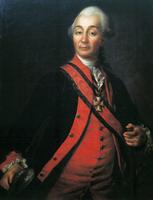
Portrait of Suvorov
Dmitry Levitzky
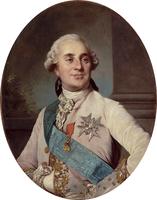
Portrait of Louis XVI, King of France and Navarre
Joseph Duplessis
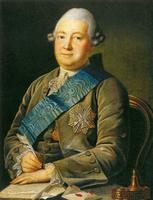
Portrait of Adam Vasilevich Olsufyev
Carl-Ludwig Johann Christineck
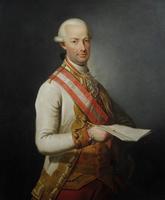
Kaiser Leopold II
Joseph Kreutzinger
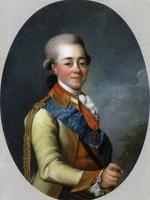
Paul I of Russia
Dmitry Levitzky
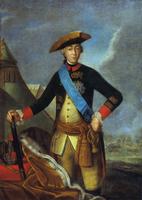
Portrait of Peter III of Russia
Fyodor Rokotov
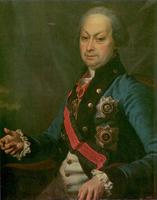
Melgunov, Alexei Petrovich, Governor-General Yaroslavl and Vologda
Dmitry Levitzky
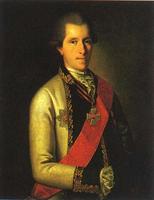
Samuil Greig
Carl-Ludwig Johann Christineck
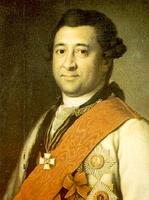
Ivan Abramovich Gannibal
Dmitry Levitzky
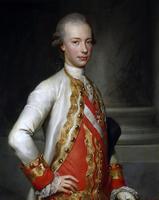
Leopold of Lorraine Grand Duke of Tuscany
Anton Raphael Mengs
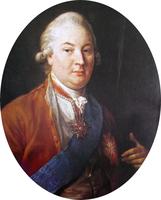
Kazimierz Raczyński
Pompeo Batoni
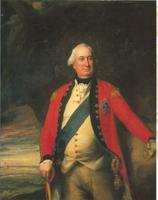
Charles Cornwallis, First Marquis of Cornwallis
John Singleton Copley
Ivan Golenishcev-Kutuzov
Dmitry Levitzky
Portrait of Iosif Igelström
Dmitry Levitzky
General Joseph Bloomfield
Charles Willson Peale
Charles IV
Francisco Bayeu y Subias
Portrait of Nikolay Borisovich Samoylov
Carl Wenig
August II the Strong
Marcello Bacciarelli