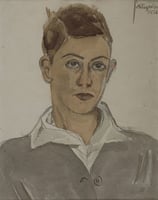
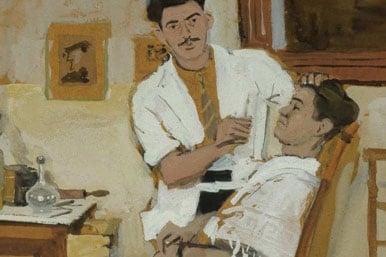
Worktime
Expert analysis of Yiannis Tsaroychis’s Worktime
Style: Expressionism · Genre: genre painting
Expert Art Historical Analysis: "Worktime" by Yiannis Tsaroychis
Yiannis Tsaroychis’s "Worktime" stands as a compelling example of mid-20th-century Greek Expressionism, a movement through which the artist synthesized European modernist sensibilities with a distinctly Hellenic social consciousness. As a genre painting—a scene of everyday life—the work moves beyond mere documentation to become an emotive, stylized commentary on labor and human dignity.
Significance within Expressionism: Tsaroychis employs the hallmarks of Expressionist practice—distorted forms, heightened color, and dynamic brushwork—to convey not the objective appearance of a workplace, but the subjective experience of labor. Unlike the often-anguished, urban Expressionism of early 20th-century Germany (e.g., Kirchner or Dix), Tsaroychis infuses his scene with a rugged, earthy vitality. The figures likely exhibit a taut, almost sculptural plasticity, their postures communicating the rhythm and strain of work. The palette, presumably leaning toward ochres, browns, and muted blues or greens, evokes the sun-scorched landscapes and humble interiors of Greece, grounding the emotional intensity in a specific cultural reality.
Genre Painting as Social Narrative: Tsaroychis’s choice of a “worktime” subject aligns him with a broader generation of Greek artists who, after the interwar period, turned their attention to the lives of ordinary people—farmers, fishermen, craftsmen, and laborers. In this context, "Worktime" is not a neutral observation but a dignified portrait of toil. The artist avoids idealization; instead, the expressive distortion suggests weariness, concentration, or even silent camaraderie. This places the work within a tradition of humanist Expressionism, where social realism meets subjective emotion.
Cultural and Historical Significance: Tsaroychis was instrumental in bringing Greek art into dialogue with modernism while maintaining local identity. "Worktime" exemplifies this synthesis: the expressive energy derives from European Expressionism, but the subject matter—rooted in Greek rural and urban life—reflects the artist’s commitment to depicting his homeland’s social fabric. The painting’s significance lies in its ability to transmute the ordinary into the emblematic, turning a moment of labor into a timeless evocation of human endurance and pride. It is a work that resonates with the post-war spirit of reconstruction and the affirmation of collective identity.
In sum, "Worktime" is significant because it demonstrates how Tsaroychis expanded the language of Expressionism beyond angst and alienation, using it instead to explore the grace, grit, and underlying humanity of everyday work—a deeply Greek yet universally resonant theme.
Genre
Style
Visually similar
20 works with related composition and palette
The Hairdresser
Mikhail Larionov
The Girl at the Barber
Mikhail Larionov
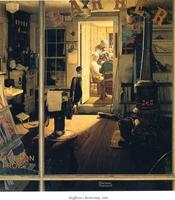
Shuffleton's Barbershop
Norman Rockwell
People
Jose Gutierrez Solana
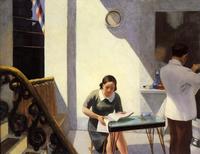
The Barber Shop
Edward Hopper
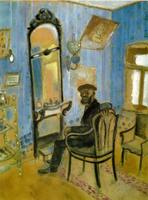
Barber's Shop (Uncle Zusman)
Marc Chagall
The Last Self Portrait
Pierre Bonnard
The Hairdresser
Jose Gutierrez Solana
Girl Getting Haircut
Elmer Bischoff
The Haido
Henri de Toulouse-Lautrec
Adiós Pelo (Goodbye Hair)
Marina Pallares
At the Hospital
Nikolay Bogdanov-Belsky
De Style
Kerry James Marshall
Berény Róbert, Orvos Portréja, 1916
Berény Róbert
At the Hairdresser
Anna Ancher
Sacha Guitry in His Dressing Room
Edouard Vuillard
Venetian Interior
John Singer Sargent
Interior with the Artist's Wife (Marie Krøyer)
Peder Severin Kroyer
Combing the Hair
Edgar Degas
From the artist's life (Portrait of Lusik Saryan in profile)
Martiros Sarian