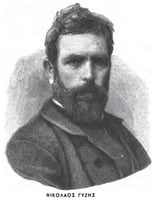
Expertenanalyse zu Nikolaos Gyziss Grandma and Children
Stil: Realism · Genre: genre painting
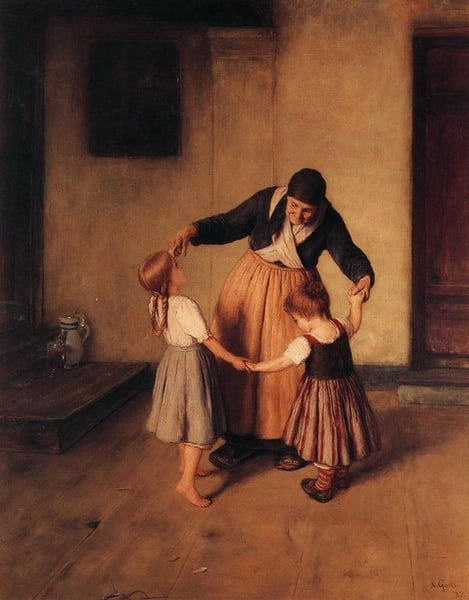
Expert Analysis: "Grandma and Children" by Nikolaos Gyzis
As a work of Realism and genre painting, "Grandma and Children" by Nikolaos Gyzis stands as a significant example of how 19th-century Greek art bridged the ideals of European Realism with intimate, domestic life. The painting’s importance lies in its unflinching yet tender depiction of everyday reality—a hallmark of the Realist movement that emerged in France and spread across Europe, rejecting romanticized or historical subjects in favor of authentic, contemporary scenes.
Gyzis, one of the leading figures of the Munich School (a group of Greek artists trained in Germany), employs a muted, naturalistic palette and careful observation of light and texture to capture a quiet, intergenerational moment. The composition centers on the grandmother’s weathered hands and thoughtful expression, while the children’s relaxed postures and absorbed gazes underscore the unpretentious rhythm of family life. This focus on ordinary people—particularly women and children—elevates the mundane to a subject worthy of serious artistic treatment, aligning with Realism’s core mission to document the social fabric of the time.
What makes "Grandma and Children" especially significant within Gyzis’s oeuvre and the broader Realist canon is its emotional restraint and psychological depth. Unlike some Realist works that lean toward social critique or sentimentality, Gyzis achieves a balance: the scene feels both specific and universal, offering a window into the values of warmth, care, and continuity in a rapidly modernizing Greece. The painting thus serves as a quiet but powerful testament to the dignity of everyday life, a central ambition of Realist genre painting.
Genre
Stil
Visuell ähnlich
20 Werke mit ähnlicher Komposition und Farbpalette
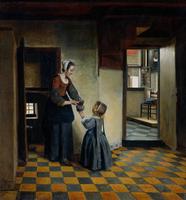
Woman and a Child in a Pantry
Pieter de Hooch
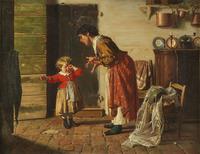
An interrupted game
Luigi Da Rios
All sorts of treasures ("The peddler")
Felix Schlesinger
Three generations
Felix Schlesinger
The overturned doll's pram
Felix Schlesinger
The errand
Pierre Jean Edmond Castan
New friends
Bertha Wegmann
?
Pierre Jean Edmond Castan
Sheared
Pierre Jean Edmond Castan
Le virtu di fido
Giuseppe Costantini
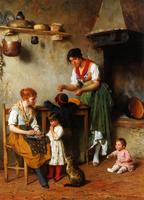
A Helping Hand
Eugene de Blaas
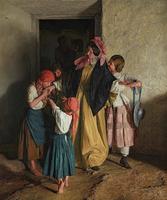
After Confirmation (The departure of the godmother)
Ferdinand Georg Waldmüller
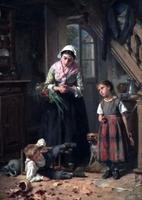
The Culprit
Pierre Jean Edmond Castan
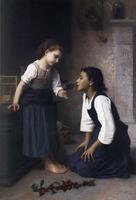
La Becquee
Elizabeth Jane Gardner
The first shoe ("children's toilet")
Felix Schlesinger
After Confiscation
Ferdinand Georg Waldmüller
Charity
Jean-Francois Millet
Servant Returning from the Market
Jean-Baptiste-Simeon Chardin
The village doctor
Felix Schlesinger
Where's My Good Little Girl?
Thomas Faed