Análisis experto de Madonna of the Passion de Carlo Crivelli
Estilo: Early Renaissance · Género: religious painting
Expert Analysis of Madonna of the Passion by Carlo Crivelli
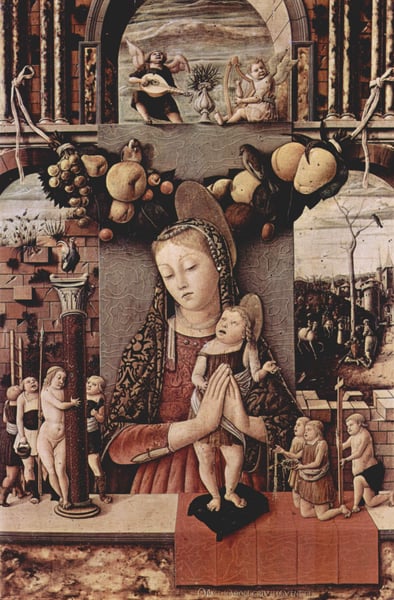
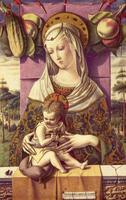
Carlo Crivelli’s Madonna of the Passion stands as a distinctive and significant example of Early Renaissance religious painting, notable for its bold synthesis of lingering Gothic ornamentation with emerging Renaissance naturalism. Crivelli, working primarily in the Marche region of Italy, developed a highly personal style that sets him apart from his Florentine and Venetian contemporaries.
Significance within the Early Renaissance
-
Archaising Opulence Meets Devotional Realism: While artists like Mantegna and Bellini were refining atmospheric perspective and classical poise, Crivelli retained a shimmering gold-ground backdrop and meticulously detailed, almost jewel-like surfaces. In Madonna of the Passion, this creates a tension between the celestial, otherworldly setting (the gold) and the intensely human, sorrowful expression of the Virgin. The painting is significant for proving that the Early Renaissance could accommodate both abstract, sacred splendor and palpable emotion.
-
Linear Precision and Emblematic Detail: Crivelli’s hallmark—crisp, incisive outlines and a wealth of symbolic objects—is central to the work. The "Passion" title points to the instruments of Christ’s suffering (e.g., nails, crown of thorns) that Crivelli typically included as precise, tactile elements. These are not merely decorative; they anchor the devotional message, inviting the viewer to meditate on Christ’s sacrifice. This combination of decorative intricacy and doctrinal clarity is a key feature of Crivelli’s contribution to religious painting.
-
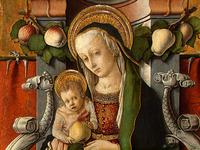
Emotional Intensity within a Formal Frame: The Virgin’s expression—often veiled sorrow or pensive melancholy—is rendered with a realism that was cutting-edge for its time. Yet Crivelli contains this emotion within a formally rigid, symmetrical composition, often with elaborate fruit or floral garlands. The result is a work that is both intellectually ordered and emotionally charged, exemplifying how Early Renaissance artists began to explore human feeling without abandoning the symbolic logic of medieval altarpieces.
In sum, Madonna of the Passion is significant because it encapsulates Crivelli’s unique position in the Early Renaissance: a master who modernized devotional imagery through psychological depth and naturalistic detail while preserving a glorious, Gothic-inspired decorative language that elevates the sacred subject.
Visualmente similares
20 obras con composición y paleta relacionadas
Madonna
Carlo Crivelli
Mystic marriage of St Catherine
Hans Memling
Virgin and Child Enthroned with two Musical Angels
Hans Memling
Madonna and Child Enthroned with Two Angels
Hans Memling
Madonna with Writing Child and St. Jerome
Pinturicchio
Virgin and Child
Rogier van der Weyden
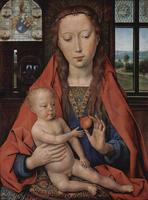
Madonna and Child, from The Diptych of Maerten van Nieuwenhove
Hans Memling
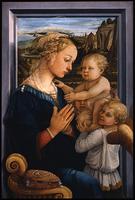
Madonna and Child with two Angels
Filippo Lippi
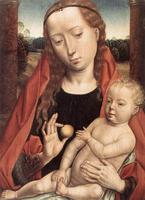
Virgin with the Child Reaching for his Toe
Hans Memling
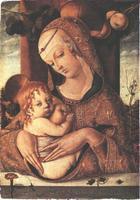
Virgin and Child
Carlo Crivelli
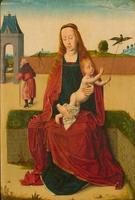
Madonna and Child on a grass bench
Dirk Bouts
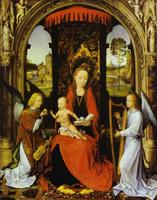
Madonna and Child with Angels
Hans Memling
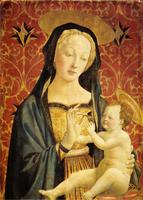
Madonna and Child
Domenico Veneziano
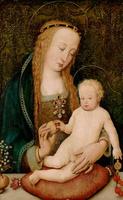
Maria, Dem Kind Einen Granatapfel Reichend
Hans Holbein the Elder
The Virgin and the Child
Sandro Botticelli
Portinari Triptych (central panel)
Hans Memling
Madonna and Child enthroned with donor
Carlo Crivelli
The Virgin and Child
Ambrogio Bergognone
Mary with child
Carlo Crivelli
Virgin and Child with An Angel
Francesco del Cossa