
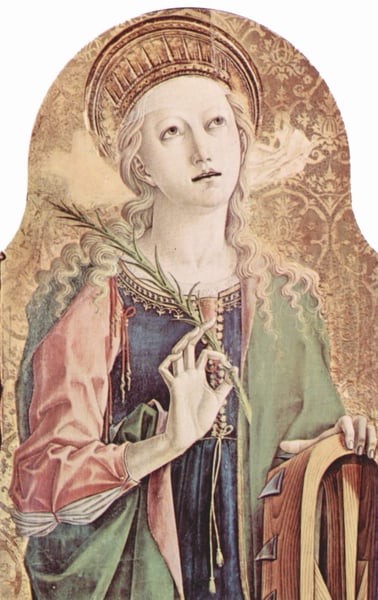
Carlo Crivelli sanatçısının Saint Catherine of Alexandria eseri hakkında uzman analizi
Tarz: Early Renaissance · Tür: religious painting
Expert Analysis: "Saint Catherine of Alexandria" by Carlo Crivelli
Carlo Crivelli’s "Saint Catherine of Alexandria" stands as a masterful example of the Early Renaissance religious painting, yet it defies the period’s predominant Florentine ideals of classical harmony and linear perspective. Instead, Crivelli retains a distinctly Late Gothic sensibility, infusing his work with a decorative opulence and emotional intensity that mark his unique significance within the era. Painted in tempera and gold on panel, the work exemplifies his characteristic fusion of Northern European precision with Italianate tenderness.
What makes this work significant:
-
Gothic Splendor Meets Renaissance Naturalism – Crivelli’s use of extensive gold leaf (for halos, brocade, and the saint’s crown) and intricate surface patterning recalls medieval altarpieces. Yet the figure of Catherine is rendered with a soft, volumetric modeling and a delicate chiaroscuro that conveys a believable, three-dimensional presence. This tension between decorative flatness and naturalistic substance defines Crivelli’s stylistic niche.
-
Symbolism as Dramatic Narrative – True to her iconography, Saint Catherine is shown with the spiked wheel of her martyrdom, the palm of victory, and a crown signifying her royal lineage and spiritual triumph. Crivelli heightens the drama by isolating her against a dark, unadorned background, focusing all attention on her serene but sorrowful expression. The exaggerated elongation of her fingers and the crisp, metallic folds of her robes amplify a sense of refined, otherworldly grace.
-
Texture and Materiality – Crivelli was a master of trompe-l’oeil effects within a sacred context. Details such as the jeweled brooch, the translucent veil, and the hair-thin gold highlights on the wheel demonstrate an almost obsessive concern with surface richness. This tactile quality—common in his work—challenges the viewer to reconcile the divine subject with the earthly, sensual beauty of its execution.
-
Devotional Intensity – Unlike the serene, idealized Madonnas of many Renaissance contemporaries, Crivelli’s Catherine is introspective and melancholic. Her downcast eyes and tightly clasped hands suggest a deep, personal piety. This psychological depth, combined with the lavish setting, creates an intimate yet majestic devotional image meant to inspire both awe and empathetic prayer.
In summary, "Saint Catherine of Alexandria" is significant because it represents a vital alternative current within the Early Renaissance—one that preserves Gothic ornamentation while embracing new naturalistic techniques. Crivelli’s work reminds us that the Renaissance was not a single, monolithic movement, but a tapestry of regional and personal expressions. Here, the saint becomes a luminous, jewel-like icon, suspended between heaven and earth, signifying Crivelli’s enduring legacy as a painter of exquisite, spiritually charged surfaces.
Görsel olarak benzer
İlişkili kompozisyon ve renk paletine sahip 20 eser

Saint Ursula
Carlo Crivelli
Mary Magdalene
Carlo Crivelli
St. Catherine
Andrea Solario
Coburg Panel
Matthias Grünewald

Annunciation (detail)
Piero della Francesca

Virgin and Child with Two Angels (detail)
Andrea del Verrocchio

Saint Mary Magdalene
Carlo Crivelli
Virgin Mary Annunciate
Fra Angelico
Magdalena Reading
Piero di Cosimo
The Virgin and Child
Ambrogio Bergognone
Madonna and Child
Fra Angelico

Saint Lucy
Álvaro Pires de Évora
Madonna
Carlo Crivelli
Saints Margaret and Apollonia
Rogier van der Weyden
The Virgin Crowned by Angels
Stefan Lochner
Madonna and Child
Domenico Veneziano
Triptych with the Virgin in the Garden of Paradise
Stefan Lochner
Madonna and Child Enthroned
Carlo Crivelli
Enthroned Madonna
Carlo Crivelli

The Virgin of the Nativity
Filippino Lippi