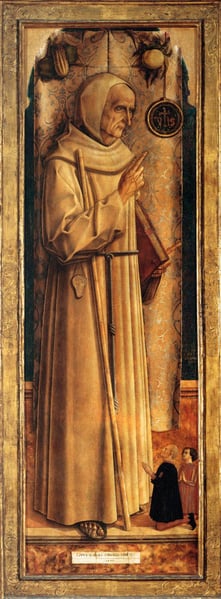
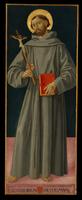
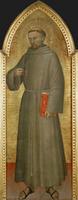
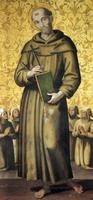
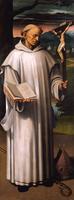
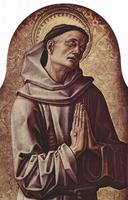
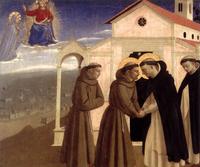
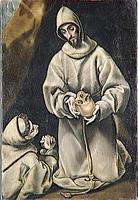
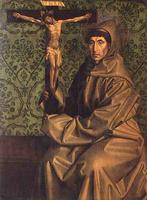
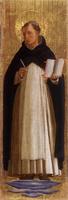
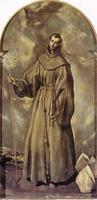
This artwork, "Saint James of the Marches with two kneeling donor" by Carlo Crivelli, is a hallmark of the Early Renaissance religious genre. Its significance lies in Crivelli’s distinctive synthesis of late Gothic decorative richness with the emerging naturalism of the Renaissance. The composition—a saint flanked by a kneeling donor—exemplifies the period’s devotional convention where patrons insert themselves as witnesses to sacred figures, asserting both personal piety and social status. Crivelli’s treatment is notable for its meticulous linear precision, often described as “gold-ground” opulence: the use of raised gesso and gold leaf creates a shimmering, almost Byzantine surface that contrasts with the more volumetric, spatially grounded figures of contemporaries like Mantegna. This work demonstrates how Crivelli retained a hieratic, frontally oriented majesty for the saint while introducing lifelike details in the donor’s portrait—an early instance of individualized donor representation. The painting thus bridges the medieval icon tradition and the Renaissance focus on observable reality, making it a key example of the regional, conservative strand of Early Renaissance art in the Marche region.