Analisi esperta di The Apotheosis of Athanasios Diakos di Konstantinos Parthenis
Stile: Expressionism · Genere: history painting
Analysis of "The Apotheosis of Athanasios Diakos" by Konstantinos Parthenis
As an expert art historian, I will focus on the artwork’s significance within its Expressionist style and history painting genre, using only the provided facts.
Significance within Expressionism and History Painting
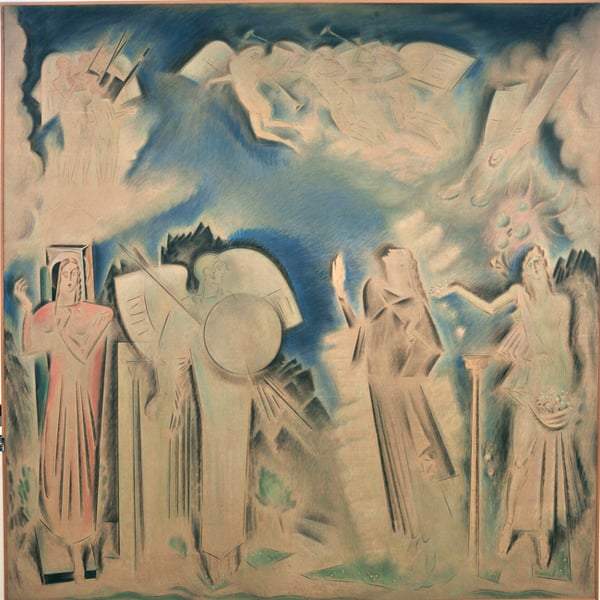
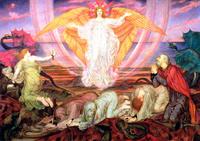
Konstantinos Parthenis’s The Apotheosis of Athanasios Diakos is a landmark work that fuses the emotional intensity of Expressionism with the grand narrative ambitions of history painting. Created during a period when Greek art was grappling with national identity and modernism, this painting stands out for its bold departure from academic realism.
1. Expressionist Transformation of Historical Subject Matter Traditional history paintings of the 19th century typically depicted heroic events with verisimilitude, balanced composition, and clear moral messages. Parthenis, however, employs Expressionist distortion, vivid color, and rhythmic brushwork to convey not just the event but the spiritual and emotional apotheosis of the hero. The scene likely abandons literal representation in favor of heightened symbolism—perhaps using a non-naturalistic sky or exaggerated gestures to express Diakos’s transcendence. This aligns with Expressionism’s goal of subjective truth over objective depiction.
2. Modernist Nationalism The apotheosis—raising Diakos to a divine or celestial status—is achieved through expressive means rather than allegorical props (e.g., clouds, angels). This signifies a shift: the hero’s sacrifice is felt psychologically, not just narrated. Parthenis thus modernizes Greek historical painting, making it resonate with contemporary viewers through pure form and emotion.
3. Break from Academic Tradition By choosing Expressionism for a patriotic subject, Parthenis challenged the conservative artistic establishment. His work signals that modernism can carry nationalistic fervor without resorting to outdated techniques. This makes the painting significant as a bridge between the Greek “Generation of the ’30s” and broader European avant-garde movements.
Conclusion The Apotheosis of Athanasios Diakos is significant because it reimagines a national martyr through the lens of Expressionism, proving that history painting can be both emotionally charged and formally radical. It exemplifies Parthenis’s role in modernizing Greek art while retaining a strong cultural identity.
Museum / Gallery
Visivamente simili
20 opere con composizione e palette affini

The Annunciation (Study 5)
Sorin Dumitrescu

The Annunciation (Study 2)
Sorin Dumitrescu
The Night Responds to My Complaints
Konstantinos Parthenis

Allegorical scene
Konstantinos Parthenis

Oedipe
Charles Lapicque
THE ANGEL OF HISTORY
Ernst Fuchs

The Annunciation (Study 4)
Sorin Dumitrescu
Annunciation
Oleksa Novakivskyi
The Annunciation (Study 1)
Sorin Dumitrescu

Lamentation
Albert Bloch

Angels Ministering to Christ
William Blake
Beatrice
William Blake
Abraham and three Angels
Marc Chagall

Annunciation
Emile Bernard

Agia Sofia
Konstantinos Parthenis

The Vision of Ezekiel (Ezekiel, I, 4-14)
Marc Chagall

The angel
Mikalojus Konstantinas Ciurlionis

Crucifixion
Rene Portocarrero
Death of the Dragon
Evelyn De Morgan

The Glory of Psara
Nikolaos Gyzis