Expert analysis of Maurice Denis’s Bacchus and Ariadne
Style: Post-Impressionism · Genre: mythological painting
Expert Analysis: "Bacchus and Ariadne" by Maurice Denis
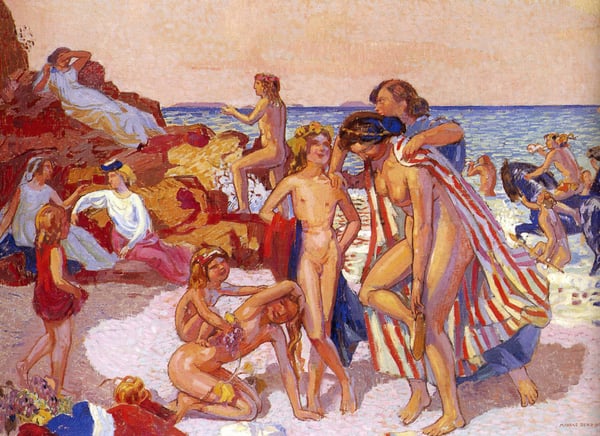
Maurice Denis’s Bacchus and Ariadne is a striking example of Post-Impressionist mythological painting that reveals the artist’s pivotal role within the Nabi movement. While the work draws on classical subject matter—the love story of the god Bacchus and the abandoned Cretan princess Ariadne—its significance lies in how Denis reinterprets the myth through a lens of symbolic color, flattened space, and decorative harmony, departing sharply from naturalistic tradition.
As a leading Nabi theorist, Denis famously declared that a painting, “before being a warhorse, a nude woman, or some anecdote, is essentially a flat surface covered with colors arranged in a certain order.” In Bacchus and Ariadne, this principle is fully realized. The composition emphasizes rhythmic, curving outlines and broad patches of luminous, unmodulated color—characteristic of Post-Impressionist synthesis rather than Impressionist transcription of light. The figures of Bacchus and Ariadne are stylized, their forms integrated into an ornamental, tapestry-like whole that prioritizes emotional and spiritual resonance over anatomical accuracy.
This approach marks a transition from late 19th-century Symbolism to early modernism. Denis’s handling of the myth is not merely illustrative but evocative: the rich, jewel-toned palette (deep blues, greens, and warm golds) suggests a dreamlike, timeless realm, while the flattened perspective emphasizes the painting’s surface as a site of pure aesthetic pleasure. The work embodies the Nabi commitment to “synthesizing” external reality with inner feeling, making the ancient story feel both immediate and transcendent.
Thus, Bacchus and Ariadne is significant as a quintessential example of Denis’s decorative, anti-naturalist aesthetic—a key moment in Post-Impressionism where mythological narrative becomes a vehicle for exploring color, form, and the very nature of pictorial representation. It stands as a bridge between the symbolist mood of the 1890s and the bold abstraction of the coming avant-garde.
Museum / Gallery
Visually similar
20 works with related composition and palette
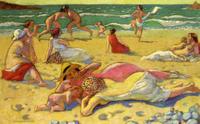
Games in the Sand (also known as Beach with Fighters)
Maurice Denis
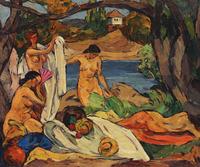
By the Water
Ion Theodorescu-Sion
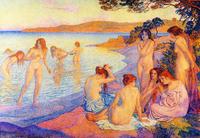
The burning time
Theo van Rysselberghe
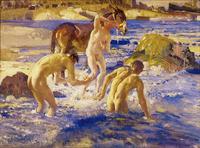
Anzacs Bathing in the Sea
George Washington Lambert
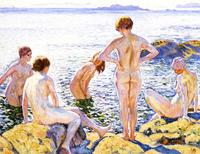
Bathers
Theo van Rysselberghe
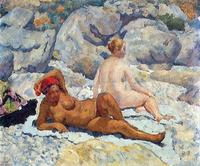
Gurzuf. Women's beach
Ilya Mashkov
The Bather
Robert Lewis Reid
Sunbathing in the Crimea
Ilya Mashkov
Distance Hills, Maine
Maurice Prendergast
Four Bathers
Theo van Rysselberghe
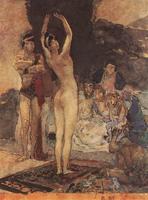
Eastern dance
Mikhail Vrubel
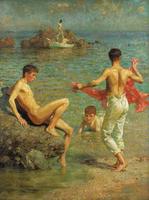
Gleaming Waters
Henry Scott Tuke
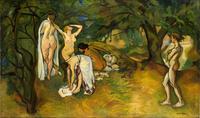
Joy of Life
Suzanne Valadon
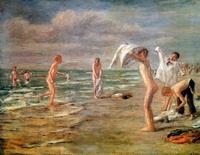
Swimming boys
Max Liebermann
Ariadne on Naxos
Alexander Rothaug
Bathers under the Pines by the Sea
Theo van Rysselberghe
Berény Róbert, Duna Parton
Berény Róbert
Idyll
Arnold Böcklin
Baigneuse
Nicolae Vermont
Bathers
Paul Cezanne