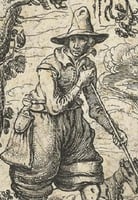
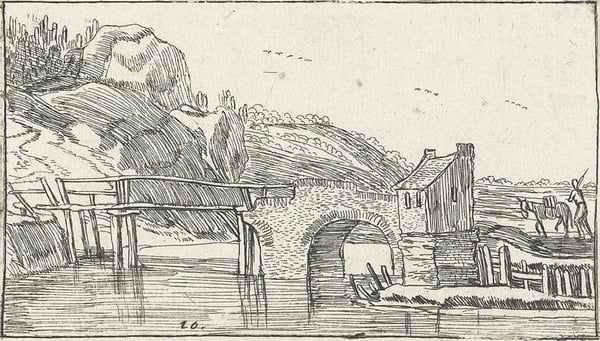
Man driving a donkey towards a bridge
詳細
Esaias van de Velde の Man driving a donkey towards a bridge の専門的な分析
スタイル:Baroque · ジャンル:landscape
Expert Analysis: "Man Driving a Donkey Towards a Bridge" by Esaias van de Velde
Esaias van de Velde (1587–1630) is a pivotal figure in the early development of Dutch Baroque landscape painting. His work stands out for its radical shift away from the fantastical, often mountainous landscapes popular in the preceding Mannerist tradition toward a naturalistic depiction of the Dutch countryside. This painting exemplifies that transition.
Significance within the Baroque and Dutch Landscape Tradition:
-
Pioneering Naturalism: Van de Velde was among the first artists to paint recognizable, local scenery—flat horizons, sandy paths, and humble structures—rather than imaginary vistas. Here, the everyday action of a man leading a donkey toward a bridge is presented with quiet dignity, elevating ordinary rural life to a subject worthy of high art. This reflects the broader Baroque interest in realism and the direct observation of nature, a hallmark of the Dutch Golden Age.
-
Atmospheric Perspective and Light: The painting likely employs a low horizon and muted tonal palette, typical of van de Velde’s early tonal phase (pre-1620s). The bridge, trees, and figures recede into a hazy, luminous distance, demonstrating an acute sensitivity to atmospheric effects. This mastery of light and air—not merely as background but as a unifying, dynamic force—foreshadows the achievements of later Dutch landscapists like Jan van Goyen (van de Velde’s pupil) and Salomon van Ruysdael.
-
Narrative of Transience: The subject—a man and his donkey crossing a bridge—functions as a subtle allegory of life’s journey, a common Baroque motif. Yet van de Velde treats it without overt moralizing, instead focusing on the quiet passage of time and human scale within a vast, unmelodramatic landscape. This understated approach marks a decisive break from the theatricality of earlier Northern Renaissance painting.
-
Influence on the Haarlem School: Van de Velde was a central figure in the so-called Haarlem school of landscape. By grounding his compositions in direct sketches from nature (he was one of the first to advocate plein-air drawing), he helped establish a native Dutch tradition that would dominate European landscape painting for centuries. This painting is a crucial early document of that shift.
In sum, "Man Driving a Donkey Towards a Bridge" is significant not for grand drama but for its quiet revolution: it treats a humble scene with meticulous observation, atmospheric unity, and a sense of calm that anticipates the mature Baroque landscape. It is a foundational work in the rise of Dutch realism.
Museum / Gallery
視覚的に類似
構図やパレットが近い作品 20 件
Road next to a waterfall
Esaias van de Velde
Rocky Landscape with road along river
Esaias van de Velde
Betharam de Lourdes à Pau
Maxime Lalanne
Landscape with farmhouse and barn on stilts at a water
Esaias van de Velde
Satire on False Perspective
William Hogarth
Path along a river with building on stilts
Esaias van de Velde
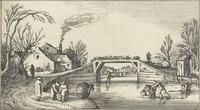
Landscape with Skaters on a bridge with sheep
Esaias van de Velde
Paysage au pont
Charles-Michel-Ange Challes
Landscape with a fisherman
Rembrandt
Farmhouse with dovecote on a river
Esaias van de Velde
Flask skaters and players on the ice in the farmyards
Esaias van de Velde
Farm near frozen river with skaters on the ice
Esaias van de Velde
Once upon a time a poor Peasant, named Crabb, was taking a load of wood drawn by two oxen to the town for sale
Arthur Rackham
Die Säule. Radierung auf Bütten mit großem
Roelant Roghman
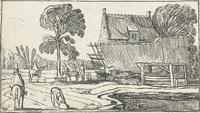
Riding on the road next to a farm
Esaias van de Velde
Landscape
Carl Schutz
Mill near the forest creek
Konstantin Bogaevsky
a Winter Scene in Kampen
Hendrick Avercamp
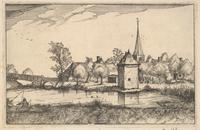
Pond and a Village, Plate 15 from Regiunculae Et Villae Aliquot Ducatus Brabantiae
Master of the Small Landscapes
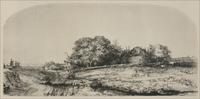
An Arched Landscape with a Flock of Sheep
Rembrandt