Expert analysis of Raoul Dufy’s The Park of Saint-Cloud
Style: Naïve Art (Primitivism) · Genre: cityscape
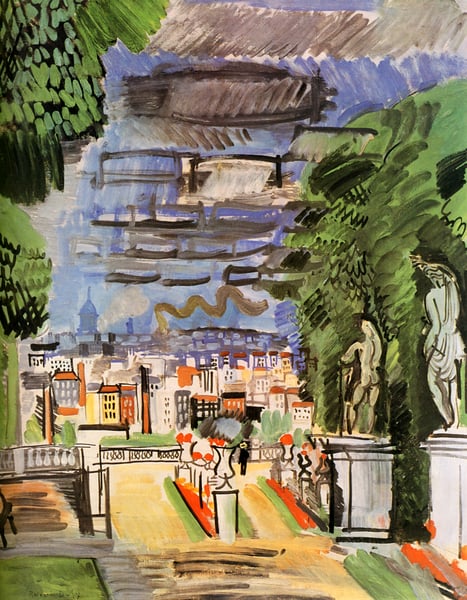
Raoul Dufy's The Park of Saint-Cloud presents a compelling intersection between the decorative spontaneity of Fauvism and the unpretentious directness of Naïve Art. While Dufy is primarily celebrated for his Fauvist and post-Impressionist works, this cityscape—categorized under Naïve Art and Primitivism—highlights his ability to distill a bustling public garden into a scene of childlike wonder and rhythmic elegance.
Significance within Naïve Art/Style:
The painting’s “naïve” quality lies in its deliberate simplification: flattened perspective, bold outlines, and a seemingly innocent disregard for naturalistic color. Dufy employs a vibrant, almost candy-like palette—emerald greens, sky blues, and touches of rose—to render the park’s trees, pathways, and strolling figures. This approach echoes the Primitivist turn away from academic precision, favoring instead an intuitive, emotional response to the subject. The crowded composition, with figures reduced to quick, calligraphic strokes, suggests a joyful hustle without losing clarity. This tension between order and chaos is a hallmark of Dufy’s mature style, but here it leans into the unstudied charm of folk art, making the everyday Parisian park feel like a fête galante reimagined through modern eyes.
Significance within the Cityscape Genre:
Unlike the sweeping, monumental cityscapes of contemporaries (e.g., Pissarro’s boulevards or Caillebotte’s stark streets), Dufy’s Park of Saint-Cloud isolates a leisurely microcosm. He focuses not on architecture but on atmosphere—the dappled light, the movement of visitors, and the organic forms of trees. In doing so, he transforms a specific location into a universal symbol of urban respite. The Naïve treatment demotes perspective in favor of pattern, aligning the park’s geometry (alleys, fountains) with the rhythmic scatter of its human occupants. This strategic “primitivism” allows Dufy to capture the park’s vivacity without resorting to photorealism, proving that simplicity can convey complexity of mood.
Overall Significance:
The Park of Saint-Cloud matters because it exemplifies how an established artist can borrow from Naïve Art not as a retreat from skill, but as a deliberate choice to prioritize pleasure and immediacy. Dufy’s work bridges high modernist painting and accessible, joyous imagery, showing that Primitivism in early 20th-century art was not merely about “untrained” vision—it was a sophisticated tool for re-enchanting the modern world. Here, the park becomes a stage where color and line dance with unforced grace, offering viewers a glimpse of paradise in the middle of the city.
Visually similar
20 works with related composition and palette
Portico with a balustrade. Arkhangelsk
Valentin Serov
The Luxembourg gardens
Zinaida Serebriakova
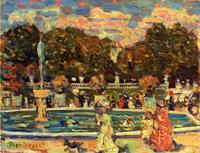
Luxembourg Gardens
Maurice Prendergast
Spring Noon
Nicolae Vermont
The Tuileries
Berthe Morisot
Luxembourg Gardens at Twilight
John Singer Sargent
Luxembourg Gardens
Samuel Peploe
Shady Paths, Vizcaya
John Singer Sargent
Luxembourg Gardens
Frederick Carl Frieseke
Essentuki. Stairs.
Pyotr Konchalovsky
Versailles Park in autumn
Zinaida Serebriakova
The red umbrella
Giovanni Boldini
Versailles
Alexandre Benois
The King walked in any weather…(Saint-Simon )
Alexandre Benois
Villa di Marlia: Lucca
John Singer Sargent
Fountain in the garden at Luxembourg
Henri Martin
View from the Garden of Versailles
Lili Elbe
In the Luxembourg Gardens
Maurice Prendergast
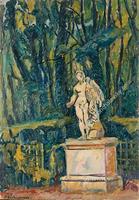
Versailles. Statue.
Pyotr Konchalovsky
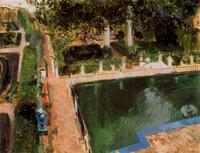
Garden of Carlos V in the Alcázar, Seville
Joaquín Sorolla