Open air show
Analisi esperta di Open air show di Theophrastos Triantafyllidis
Stile: Impressionism · Genere: genre painting
Expert Analysis of "Open Air Show" by Theophrastos Triantafyllidis
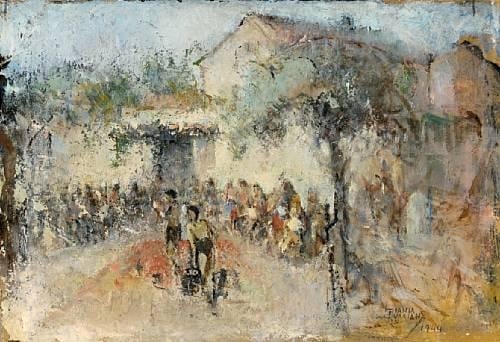
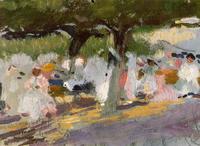
Theophrastos Triantafyllidis’s Open Air Show is a compelling example of how Impressionist principles—born in France—were adapted to capture distinctly Mediterranean subjects and social customs. Executed in an Impressionist style and classified as a genre painting, the work derives its significance from its fusion of two core Impressionist ambitions: the depiction of ephemeral light and atmosphere, and the celebration of modern leisure.
Stylistic Significance within Impressionism
The painting likely employs the hallmark Impressionist techniques of broken brushwork, high-keyed color, and a focus on the play of natural light. The "open air" setting aligns perfectly with the movement’s plein air practice, where artists sought to capture the immediate sensory experience of a scene rather than a polished studio composition. The subject—an outdoor show—allowed Triantafyllidis to render shifting light on faces, costumes, and the surrounding environment, embodying the Impressionist preoccupation with transient moments and optical truth.
Genre Painting as Social Documentation
As a genre scene, Open Air Show records a lively, everyday social ritual: a public performance likely in a town square or park. This choice is significant because the Impressionists often turned to such vernacular subjects—theatrical performances, café concerts, fairs—to document the changing fabric of urban and suburban life. By focusing on the audience’s engagement (rather than a heroic or mythological narrative), the painting elevates a fleeting, ordinary experience into a subject worthy of serious artistic attention. It thus reflects the late-19th‑century shift toward capturing contemporary existence, a key legacy of Impressionism.
Cultural Context
Triantafyllidis’s work is particularly notable for situating Impressionist principles within a Greek context. While the painting’s style owes much to French Impressionism, its subject matter—an outdoor show in what appears to be a local setting—offers viewers a window into a specific cultural milieu. The artist contributes to the spread of Impressionism beyond Western Europe, adapting its visual language to the unique light, architecture, and social pastimes of Greece. In this sense, Open Air Show stands as a bridge between the international Impressionist movement and regional identity, demonstrating how the style could be both universal and locally meaningful.
Conclusion
Open Air Show is significant for its seamless integration of Impressionist technique with the genre-painting tradition, documenting a moment of shared public enjoyment under natural light. It exemplifies the movement’s core values—immediacy, luminosity, and the celebration of modernity—while also marking the adaptation of these ideals to a Greek artistic context. The painting remains a vibrant record of a time and place, capturing the essence of a lively open-air performance with the freshness and spontaneity that defines Impressionism at its best.
Genere
Stile
Visivamente simili
20 opere con composizione e palette affini
Au bord du désert
Theo Gerber
Landscape with "sinners" Puvis de Chava
Georges Seurat
Three Graces
Eugene Leroy
Flea Market
Theophrastos Triantafyllidis
Bela Adalbert Czobel, Cagnes
Bela Czobel
Nannies in the park
Theophrastos Triantafyllidis
Berény Róbert, Idill a Szabadban
Berény Róbert
Sunday in Breaza
Margareta Sterian
Nude in Garden
Richard Gerstl
Landstrasse
Varlin
Adam and Eve
Eugene Leroy
Herrick's Blossoms
Charles Conder
Landscape
Abraham Manievich
Ambassadors of hunger
Pellizza da Volpedo
Szentendre
Bela Czobel
Lions head to Signal Hill from Windmere Cape
Gregoire Boonzaier
The feast of the frittola (sketch)
Giacomo Favretto
Réve Bleu
Theo Gerber
Under the tamarinds (San Sebastian)
Joaquín Sorolla
Towards the Noon
Adam Baltatu