Analisi esperta di Portrait of Maria Pavlovna Druzhinina di Pavel Fedotov
Stile: Realism · Genere: portrait
Expert Analysis: "Portrait of Maria Pavlovna Druzhinina" (c. 1848) by Pavel Fedotov
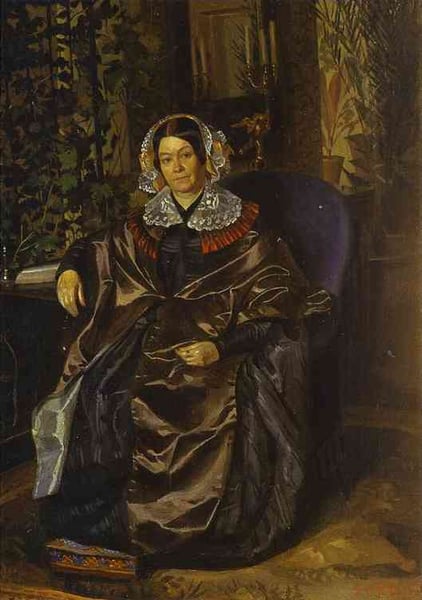
This portrait is a striking example of Russian Realism’s shift from idealized, aristocratic representation toward a more psychologically truthful and socially aware depiction of the sitter. Pavel Fedotov, primarily celebrated for his satirical genre scenes of 19th-century Russian life, here applies the same observational rigor to portraiture—a genre he practiced less frequently but with profound sensitivity.
Significance within the Realist style and period:
-
Psychological penetration over flattery: Unlike the academic portrait tradition that emphasized status symbols and idealized beauty, Fedotov focuses on Maria Pavlovna Druzhinina’s inner life. Her direct, slightly weary gaze, the subtle asymmetry of her features, and the naturalistic handling of light on her face all convey a distinct individuality. The viewer senses a woman of intellect and quiet resilience—a break from the passive, decorative roles often assigned to female sitters in earlier Russian portraiture.
-
Compositional restraint and social context: Fedotov eliminates distracting props or grand settings. The dark, unadorned background and simple clothing suggest a middle-class or intellectual milieu. This aligns with the Realist interest in portraying everyday people without theatrical grandeur. Druzhinina’s identity—as a member of the intelligentsia—reflects the burgeoning importance of educated, non-aristocratic subjects in mid-19th-century Russian art.
-
Technical mastery in service of truth: Fedotov’s brushwork is precise yet not fussy. He models the face with subtle tonal transitions, while the clothing is rendered with broader, more economical strokes. This technique—common among Realists—prioritizes the illusion of lived presence over decorative finish. The subdued palette (browns, grays, and warm flesh tones) reinforces the mood of introspective realism.
Legacy: As one of Fedotov’s rare formal portraits—executed during his final years before his early death—this work bridges his satirical genre scenes and the deeper psychological realism that would later flourish in the works of the Peredvizhniki (The Wanderers). It demonstrates that for Fedotov, every face carried a story, and that the realist mission was not merely to document, but to reveal the complexity of human character within its social moment.
Visivamente simili
20 opere con composizione e palette affini
Portrait of Elizaveta Petrovna Zhdanova
Pavel Fedotov
Portrait of O. P. Zhdanovich
Pavel Fedotov
Elisabeth Imrédy, Edle Von Omorovicze
August von Pettenkofen
Portrait of E. P. Protasyeva
Vasily Tropinin
Portrait of Oline Cecilie Bruun née Plum
Christian Albrecht Jensen
Mary Digges
Thomas Lawrence
Portrait of Amalia Legrand
Pavel Fedotov
Portrait of Fanny Holman Hunt
William Holman Hunt
Gertrude, Duchess of Bedford
Joshua Reynolds
Portrait of N. P. Chernyshova
Pavel Fedotov
Portrait of the Young Lady with Green Dress
Konstantin Makovsky
Portret Damy
Leon Wyczółkowski
Portrait of A. P. Zhdanovich
Pavel Fedotov
Josefine Schwartz Von Mohrenstern, Born Vicomtesse Goupy De
Ferdinand Georg Waldmüller
Portrait of Ye. P. Zhdanovich
Pavel Fedotov
EV Meshkov, née. Bilibin
Vasily Tropinin
Mrs. Francis Hurt
Joseph Wright
Marie Leszczyńska, Queen of France, Reading the Bible
Jean-Marc Nattier
Mrs.Thomas Boylston
John Singleton Copley
Portrait of Nadezhda Polovtsova
Carolus-Duran