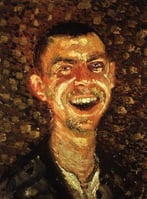
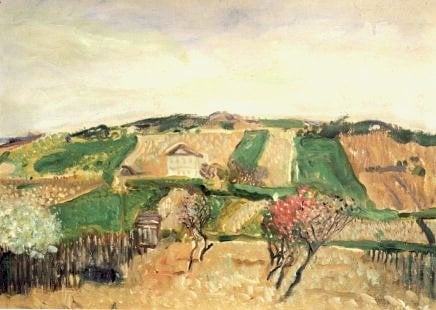
Analisi esperta di Grinzing di Richard Gerstl
Stile: Post-Impressionism · Genere: landscape
Expert Analysis of "Grinzing" by Richard Gerstl
Richard Gerstl’s "Grinzing" stands as a compelling testament to the radical edge of Post-Impressionist landscape painting in early 20th-century Vienna. While the movement is often associated with French artists like Cézanne, van Gogh, and Gauguin, Gerstl’s work exemplifies how Post-Impressionist principles—particularly the expressive use of color, dynamic brushwork, and a subjective approach to nature—were adapted and intensified in Central Europe.
Significance within Post-Impressionism
-
Bridging to Expressionism: Gerstl’s landscapes, including this view of the Viennese suburb Grinzing, push Post-Impressionism toward an almost proto-Expressionist intensity. Unlike the more structured compositions of Cézanne or the pointillist techniques of Seurat, Gerstl employs aggressive, unblended strokes and heightened, non-naturalistic colors to convey emotional resonance. This marks him as a pivotal figure who deepened the subjective, psychological dimension inherent in Post-Impressionism, directly anticipating the Austrian Expressionism of his contemporaries Schiele and Kokoschka.
-
Rejection of Academic Naturalism: In line with Post-Impressionism’s core rebellion, "Grinzing" abandons precise topographical depiction. Gerstl’s treatment of the landscape—likely characterized by vigorous impasto and compressed space—focuses on the painter’s internal response to the scene rather than faithful representation. This aligns with the movement’s emphasis on personal vision over objective reality.
-
Historical and Artistic Context: Gerstl’s career was tragically short (he died in 1908 at age 25), and he was largely unknown during his lifetime. "Grinzing" gains significance as part of his small but fiercely original body of work, created in isolation from the Viennese art establishment. He essentially reinvented Post-Impressionist landscape idioms without direct exposure to French avant-garde circles, giving his landscapes a raw, unmediated quality that sets them apart from more polished contemporary works.
Conclusion
"Grinzing" is significant not only as a fine example of Post-Impressionist landscape genre but as a marker of the moment when the movement’s freedom of color and form began to rupture into Expressionism. Gerstl’s uncompromising style—his willingness to distort for emotional effect—makes this painting a crucial link in the chain from late-19th-century plein-air revolution to early-20th-century angst-ridden modernism. It is a powerful reminder that Post-Impressionism’s legacy extended well beyond France, and that its most daring practitioners sometimes emerged at the margins.
Genere
Stile
Visivamente simili
20 opere con composizione e palette affini
Railway to the Kahlenberg
Richard Gerstl
Landscape in Provence
Paul Cezanne
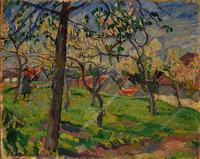
Apple tree in blossom
Pyotr Konchalovsky
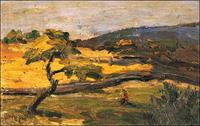
Landscape
Nikolaos Lytras
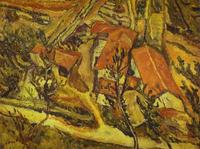
Landscape
Chaim Soutine
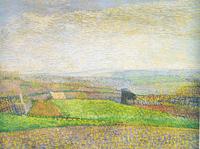
Paysage Du Vexin
Louis Hayet
Children Playing in the Fields
Alfred Sisley
The Sea Seen from Collioure
Henri Matisse
An Apple Tree at Eragny
Camille Pissarro
An Autumn Evening near Paris
Alfred Sisley
Plain by Mont Sainte-Victoire
Paul Cezanne
Peach Trees in Blossom
Vincent van Gogh
Bela Adalbert Czobel , Passage
Bela Czobel
The Thierceville Road, Early Spring
Lucien Pissarro
Field with Poppies
Vincent van Gogh
Dauphine Landscape
Pierre Bonnard
Village in Spring
Gustave Loiseau
Autumn Landscape
Maurice de Vlaminck
Garden near Rome. Peaches in bloom.
Pyotr Konchalovsky
Landscape
Hippolyte Petitjean