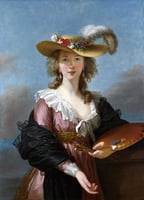
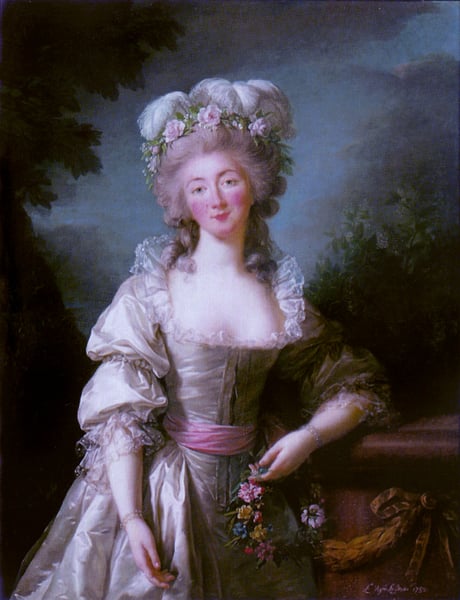
Analisi esperta di Portrait of Madame du Barry di Louise Elisabeth Vigee Le Brun
Stile: Rococo · Genere: portrait
Expert Analysis: "Portrait of Madame du Barry" by Louise Élisabeth Vigée Le Brun
This portrait is a quintessential example of late Rococo portraiture, crafted by one of the most celebrated female painters of the 18th century. Vigée Le Brun’s depiction of Madame du Barry—the last chief mistress of King Louis XV—is significant for several reasons.
1. Mastery of Rococo Aesthetics
The painting embodies the Rococo style’s hallmark delicacy, sensuality, and ornamental charm. Vigée Le Brun employs a soft, pastel palette, fluid brushwork, and an emphasis on luxurious fabrics and natural surroundings. Madame du Barry is typically shown in a flowing, silken gown adorned with roses, her powdered hair styled with flowers and pearls—all elements that align with Rococo’s celebration of aristocratic pleasure and grace.
2. Subversion of Gender and Power in Portraiture
As a female artist painting a woman of controversial public status, Vigée Le Brun reframes du Barry not as a scandalous courtesan but as an elegant, composed patron of the arts. The portrait emphasizes her refinement and intelligence, challenging the moralizing narratives that often surrounded her. This nuanced portrayal reflects the artist’s own navigation of a male-dominated profession and her ability to empower her female sitters.
3. Transition from Rococo to Neoclassicism
Painted in the 1780s, the work subtly bridges Rococo’s playful luxury with a growing Neoclassical interest in naturalism and restrained elegance. Vigée Le Brun’s avoidance of excessive artifice—focusing on du Barry’s direct gaze, naturalistic flora, and simplified background—foreshadows the shift in taste that would soon dominate French art.
4. Historical Document of Pre-Revolutionary France
The portrait captures the final days of the Ancien Régime. Du Barry, a symbol of royal opulence and moral ambiguity, would be executed during the Reign of Terror. Vigée Le Brun herself fled France in 1789. Thus, the painting stands as a poignant, luminous record of the aristocratic world that was about to vanish.
Significance within Rococo and Portrait Tradition
While many Rococo portraits prioritize decorative frivolity, Vigée Le Brun’s work integrates psychological depth with the style’s inherent charm. Her ability to convey both the sitter’s social standing and her individual presence elevates the portrait beyond mere court flattery. This painting, alongside her famous self-portraits, solidifies Vigée Le Brun’s reputation as a master who used Rococo’s elegance to explore themes of identity, agency, and beauty in a turbulent era.
Visivamente simili
20 opere con composizione e palette affini
Queen Marie Antoinette of France
Louise Elisabeth Vigee Le Brun
Madame Louise of France
Jean-Marc Nattier
Anne or Molly Cracroft
Joseph Wright
Portrait of the Countess Maria Benedetta Di San Martino
Pompeo Batoni
Portrait of Anna Davia (D'Avia) Bernucci
Dmitry Levitzky
Margaretta Mabella Acworth (1727–1794)
Thomas Hudson
Portrait of Mrs. Drummond
Thomas Gainsborough
Alexandra Iosifovna, Grand Duchess of Russia, Princess Alexandra of Altenburg
Franz Xaver Winterhalter
Mrs. Hugh Bonfoy
Joshua Reynolds
Portrait of Unknown Woman with a rose
Dmitry Levitzky
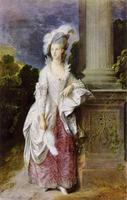
The Honorable Mrs. Graham
Thomas Gainsborough
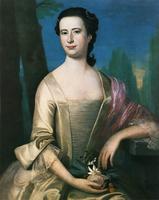
Portrait of a Woman
John Singleton Copley
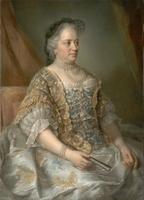
Portrait of Maria Theresa, Sovereign of Austria, Hungary and Bohemia
Jean-Étienne Liotard
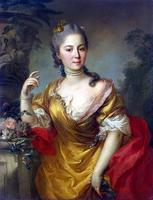
Anna Chernysheva
Stefano Torelli
Madame Bergeret
Francois Boucher
Izabella Poniatowska Branicka
Marcello Bacciarelli
Marie-Louise, Princesse De Lamballe
Joseph Duplessis
Clarissa
John Everett Millais
Madame de La Porte
Jean-Marc Nattier
Portrait of Anne-Félicité Grésille
Marie-Gabrielle Capet