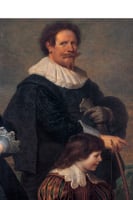
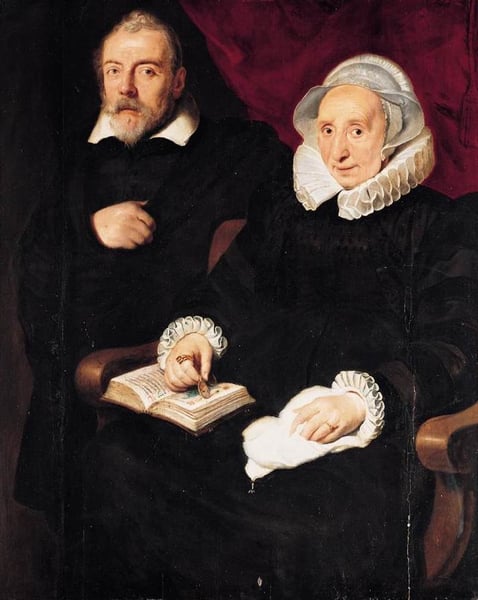
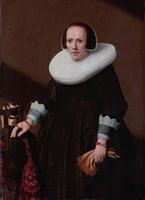
Portrait of Elisabeth Mertens and her Late Husband
Détails
Analyse experte de Portrait of Elisabeth Mertens and her Late Husband de Cornelis de Vos
Style : Baroque · Genre : portrait
Expert Analysis: "Portrait of Elisabeth Mertens and her Late Husband" by Cornelis de Vos
This work is a striking example of Baroque portraiture that transcends mere likeness to become a meditation on memory, fidelity, and the passage of time. Painted by the Flemish master Cornelis de Vos (c. 1584–1651), the portrait is notable for its poignant narrative: Elisabeth Mertens is shown alongside her deceased husband, a conceit that merges the conventions of the portrait historié with the Baroque fascination for emotional immediacy and vanitas symbolism.
Significance within the Baroque Period
-
Innovative Memento Mori Theme: Unlike standard double portraits of married couples, this composition includes the husband as a posthumous presence—either as a painted portrait within the painting, a spectral figure, or a symbolic bust. This device was rare in 17th-century Northern European portraiture and reflects the Baroque interest in the boundary between life and death. De Vos creates a layered reality: the living sitter interacts with a representation of the deceased, forcing the viewer to contemplate mortality while celebrating marital devotion.
-
Emotional Realism and Psychological Depth: De Vos, a contemporary of Rubens and van Dyck, brings a restrained psychological intensity to the scene. Elisabeth’s expression and gesture—often a hand resting on the husband’s image or a mourning veil—convey grief without theatrical excess. This aligns with Baroque portraiture’s shift from static formality to capturing a “frozen moment” of human feeling.
-
Technical Mastery of Texture and Light: The work exemplifies Baroque chiaroscuro and meticulous handling of fabrics (silk, lace, velvet). De Vos uses warm, rich flesh tones and subtle transitions of light to model the figures, while the darker background heightens the dramatic focus. The contrast between the vitality of Elisabeth’s depiction and the stiff, memorialized image of her husband underscores the temporal divide.
-
Reflection of Patronage and Social Values: Commissioned likely as a private family memorial, the painting functioned as a devotional object and a testament to the sitter’s social standing and piety. It also documents the role of widows in 17th-century Flemish society, who were expected to preserve their husband’s memory through such artworks—a practice common among the bourgeoisie.
Why It Matters
“Portrait of Elisabeth Mertens and her Late Husband” stands out because it synthesizes the Baroque love of drama, the genre of domestic portraiture, and a proto-elegiac sensibility. It offers a window into how art reconciled grief with the desire for permanence, making it not just a portrait but a visual document of how the Baroque era confronted mortality with both solemnity and beauty.
Museum / Gallery
Visuellement similaire
20 œuvres à la composition et à la palette proches
Portrait of a Married Couple
Anthony van Dyck
Portrait of the wife of Johan Wierts
Jacob Jordaens
Double Portrait of the Painter Frans Snyders and his Wife
Anthony van Dyck
Portrait of a woman
Frans Hals
Portrait of Johan Wierts
Jacob Jordaens
Portrait of Ludovicus Nonnius
Peter Paul Rubens
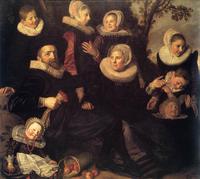
Family Group in a Landscape
Frans Hals

Wife of an Aristocratic Genoese
Anthony van Dyck
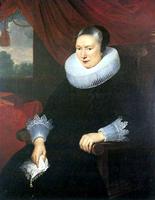
Portrait of a lady
Cornelis de Vos
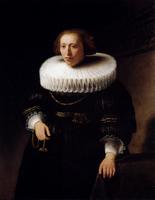
Portrait Of A Woman
Rembrandt
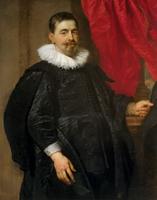
Portrait of a Man, Probably Peter Van Hecke
Peter Paul Rubens
Portrait of old lady
Gortzius Geldorp
Portrait Of The Artist's Wife
Joachim Wtewael
Maritge Voogt Claesdr
Frans Hals
Four Governors of the Amsterdam Leper Asylum
Ferdinand Bol
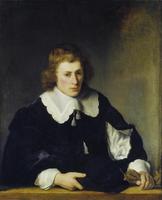
Portrait of a Young Man
Ferdinand Bol
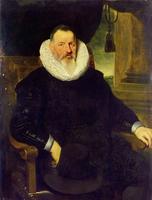
Portrait of a Man
Cornelis de Vos
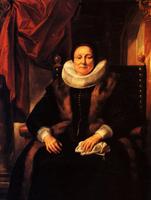
Portrait of a lady sitting in a chair
Jacob Jordaens
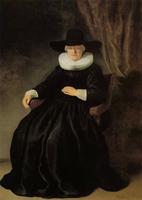
Maria Bockennolle, Wife of Johannes Elison
Rembrandt
Geertruyd Reael, Wife of Philips Denijs
Huygh Pietersz Voskuyl