Analisi esperta di Girl di Thalia Flora-Karavia
Stile: Expressionism · Genere: portrait
Expert Analysis: "Girl" by Thalia Flora-Karavia
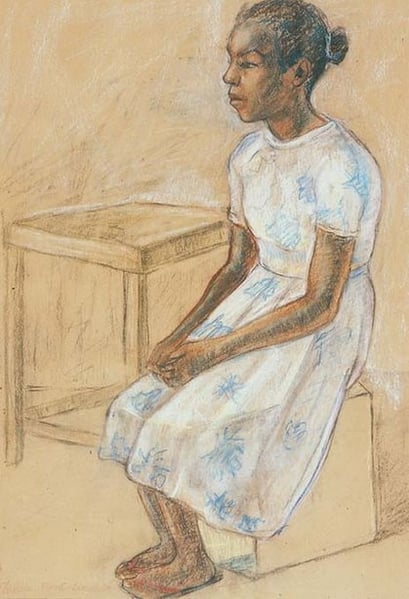
Thalia Flora-Karavia’s Girl stands as a compelling example of early 20th‑century Expressionist portraiture, notable both for its stylistic intensity and for the artist’s pioneering role within Greek modernism. Although the work’s specific visual details are not supplied here, its classification as an Expressionist portrait immediately signals a departure from naturalistic representation toward the evocation of inner psychological states. In keeping with the movement’s core principles, Flora-Karavia likely deploys bold, non‑naturalistic color, vigorous brushwork, and a degree of distortion or simplification to convey the sitter’s emotional essence rather than mere physical likeness.
Significance within Expressionism:
- Emotional immediacy – Expressionist portraits prioritize the subject’s subjective experience. Flora-Karavia’s Girl would channel raw emotion—perhaps vulnerability, defiance, or introspection—through exaggerated facial features or a charged palette.
- Rejection of academic realism – Like her German Expressionist contemporaries (e.g., Kirchner, Schiele), Flora-Karavia breaks from conventional perspective and modeling, emphasizing jagged lines or flattened planes to create a sense of urgency and modernity.
- Female perspective – As a woman working within a predominantly male avant‑garde, Flora‑Karavia’s interpretation of a “girl” likely avoids passive idealization, instead offering a psychologically complex, empowered, or uneasy subject.
Context and Legacy: Flora‑Karavia was a central figure in the establishment of Expressionism in Greece after training in Munich, a key Expressionist hub. Girl thus not only reflects broader European trends but also marks a significant contribution to the modernization of Greek portraiture. Her work challenges the conservative Byzantine‑influenced traditions of her homeland, introducing a vocabulary of intense color and gestural freedom.
In sum, Girl is significant because it exemplifies how a female artist adapted the radical formal language of Expressionism to explore personal and cultural identity, while also affirming the movement’s goal of making visible the turbulence of the human psyche.
Visivamente simili
20 opere con composizione e palette affini
Valya
Minas Avetisyan
Adelita
Jean Jansem
Portrait of the Son of Robert de Comecy
Odilon Redon
Menina triste e doente
Jose Pancetti
Modok Mária, Ülő Lány
Modok Mária
Untitled
Dilek Demirci
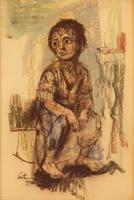
Niño
Juan Carlos Castagnino
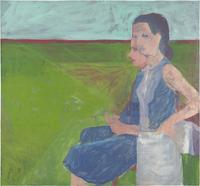
Women Outside
Richard Diebenkorn
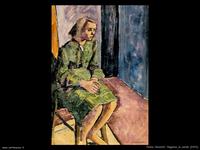
Ragazza in verde
Felice Casorati
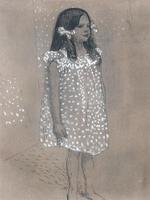
Greti
Cuno Amiet
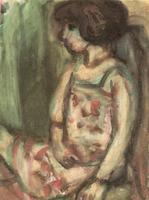
Young Girl Sitting
Bela Czobel
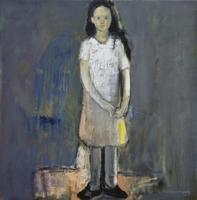
Untitled
Dilek Demirci
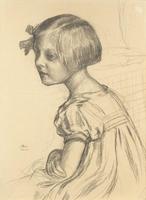
Mademoiselle Nele Van de Velde
Theo van Rysselberghe
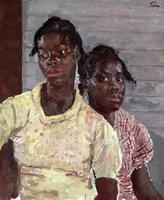
The Two Jamaican Girls
Augustus John
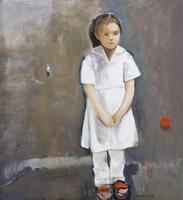
Untitled
Dilek Demirci
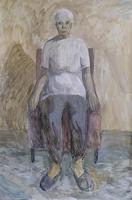
Holy Dementia
Kateryna Lysovenko
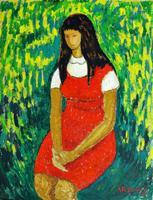
Girl in Red
George Stefanescu
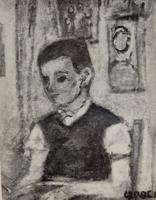
Czobel Béle Kisfiu
Bela Czobel
Portrait of a Young Indian
Fernando Botero
Marilena
Felice Casorati