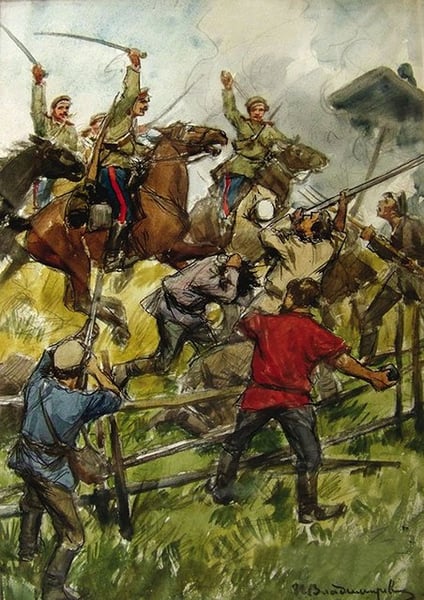
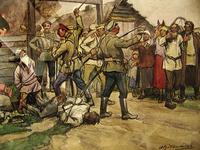
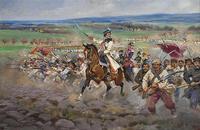
This work, The Revolt of the Peasants on the Estate of Prince Shahovskoy by Ivan Vladimirov, is a powerful example of Russian Realist genre painting. Its significance lies in its unflinching depiction of social conflict and class struggle, a core concern of the Realist movement. Rather than idealizing peasant life or aristocratic authority, Vladimirov captures a moment of direct confrontation—a revolt—that makes visible the simmering tensions within the Russian feudal system.
The painting's importance within the Realist tradition is twofold. First, it adheres to the Realist mandate of portraying contemporary life truthfully and without romanticism, focusing on a specific historical or social event. Second, it uses genre painting—typically reserved for everyday scenes—to elevate a political uprising to the level of serious artistic subject matter. By placing the revolt on a prince's estate, Vladimirov directly engages with the inequities of the era, foreshadowing the broader revolutionary upheavals that would define early 20th-century Russia. The work thus stands as a document of its time, using Realism's commitment to honest observation to critique social hierarchy and advocate for historical awareness.