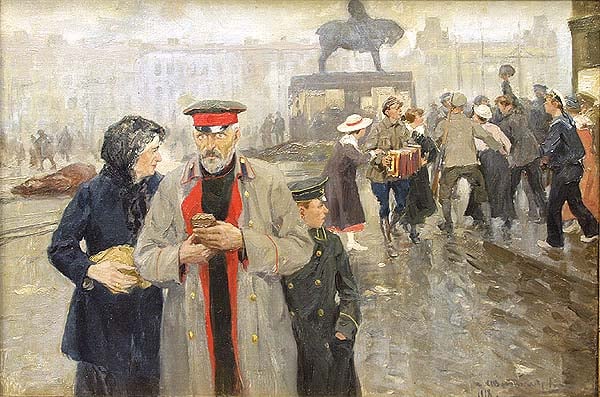
On the streets of Petrograd
Dettagli
Analisi esperta di On the streets of Petrograd di Ivan Vladimirov
Stile: Realism · Genere: genre painting
Expert Analysis: Ivan Vladimirov’s On the Streets of Petrograd
Ivan Vladimirov’s On the Streets of Petrograd is a masterful example of Realist genre painting that captures a pivotal moment in Russian history. The work belongs to Vladimirov’s celebrated series documenting the 1917 Russian Revolution, though the title specifically points to the renamed capital—Petrograd—during the upheaval of World War I and the subsequent Bolshevik uprising.
Significance within Realism
Vladimirov adhered to the core tenets of 19th-century Realism—truthful observation of everyday life, unidealized subjects, and social commentary. However, his approach was distinctly historical: he treated revolutionary street scenes as “modern genre painting,” treating ordinary citizens, soldiers, and workers not as allegorical figures but as specific individuals caught in extraordinary times. The artist’s meticulous attention to period detail (uniforms, barricades, leaflets, winter clothing) grounds the scene in palpable reality, allowing the viewer to feel the tension of a city in transition.
Genre Painting as Historical Witness
Unlike many Romantic or Academic depictions of revolution, Vladimirov avoids heroic posturing. Instead, he focuses on the mundane yet charged activities of Petrograd’s streets—crowds reading proclamations, soldiers mingling with civilians, possibly the ration lines or impromptu political debates. This “slice-of-life” approach elevates a genre typically associated with rustic or domestic scenes into a documentary tool. The painting becomes a primary visual source for understanding how ordinary Russians experienced the collapse of the Tsarist state and the rise of Soviet power.
Artistic Techniques
Vladimirov’s palette is earth-toned and muted, reflecting the gray winter skies and gritty urban environment. He employs a horizontal composition to create depth along the street, leading the eye past varied groups of figures, each engaged in a distinct action. The loose but controlled brushwork suggests both the haste of reportage and the deliberate construction of a balanced composition—a hallmark of Russian Realism influenced by the Peredvizhniki (Wanderers) tradition.
Historical and Cultural Impact
On the Streets of Petrograd is significant because it bridges art and primary-source chronicle. At a time when photography was still limited, Vladimirov’s paintings served as vivid, accessible records for a largely illiterate population. Today, the work stands as an invaluable visual testimony to the chaos and hope of revolutionary Petrograd, making it a key piece for scholars of both art history and Russian revolutionary studies.
In summary, Vladimirov’s painting achieves significance by transforming a traditional genre into a vehicle for immediate, unflinching realism—a window onto a world that was, at the moment of its creation, still being forged.
Visivamente simili
20 opere con composizione e palette affini
The former
Ivan Vladimirov
Зустріч
Микола Пимоненко
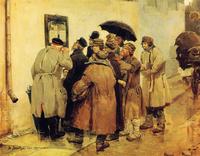
News from the Front
Viktor Vasnetsov
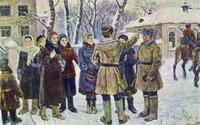
Where to give blood here?
Pyotr Konchalovsky
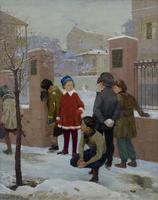
Did they teach you that in school
Grigor Khanjyan
Berény Róbert, Budapest Felszabadítása
Berény Róbert
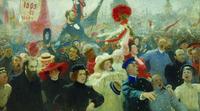
Manifestation. October 17, 1905
Ilya Repin
Pioneer Tie
Sergiy Grigoriev
Бесіда
Микола Пимоненко
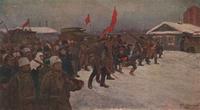
The revolt of the soldiers and workers in the days of February 1917
Ivan Vladimirov
At the workers' outskirts of the days of the overthrow of the autocracy. February 1917
Ivan Vladimirov
Old couple
Vladimir Makovsky
Winter
Oleksandr Murashko
Old schoolmates sitting on a bench at Lille Triangel in Copenhagen
Erik Henningsen
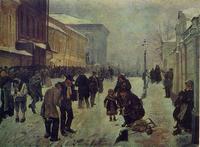
Looking for a shelter for the night
Vladimir Makovsky
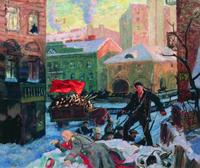
Petrograd on February
Boris Kustodiev
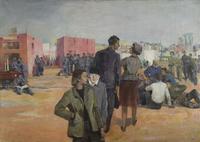
Fajrant W Nowej Hucie
Andrzej Wróblewski
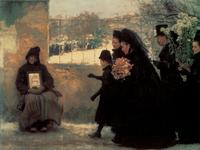
All Saints' Day
Émile Friant
People Strolling on the Beach
Vincent van Gogh
The First of November
Hans Andersen Brendekilde