
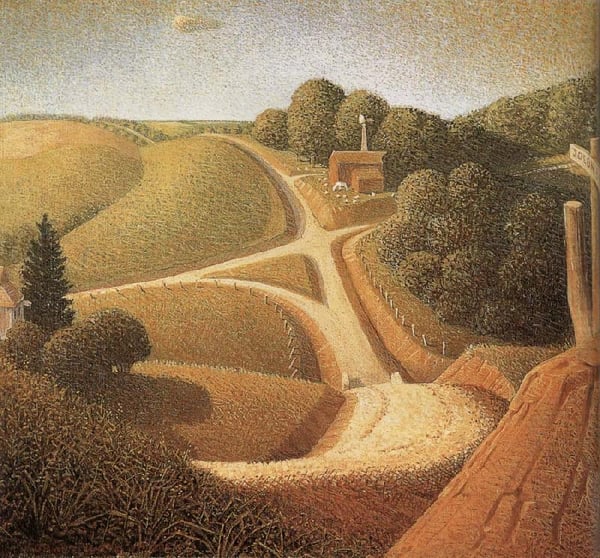
Expertenanalyse zu Grant Woods New Road
Stil: Regionalism · Genre: landscape
Grant Wood’s New Road is a quintessential example of Regionalism, the early 20th-century American movement that sought to depict the authentic, rural heartland in contrast to the abstraction and urban focus of European modernism. As a landscape, the work anchors its significance in the way it transforms a seemingly mundane subject—a newly constructed road cutting through rolling farmland—into a quiet meditation on progress and tradition. The road itself becomes a compositional device that leads the viewer’s eye into the depth of the scene, while Wood’s meticulous, almost stylized realism (with smooth brushwork and simplified forms) emphasizes the order and integrity of the Midwestern terrain. This painting captures the tension between change and stability that defines Regionalist art: the unpaved path suggests modernity encroaching on a timeless agrarian world, yet Wood’s affectionate, clean depiction ensures the landscape remains dignified and enduring. Within Wood’s oeuvre, New Road reinforces his commitment to celebrating local scenery without sentimentality, making it a valuable document of an era when American art turned inward to define a national identity through its land.
Genre
Stil
Visuell ähnlich
20 Werke mit ähnlicher Komposition und Farbpalette
Spring Plowing
Grant Wood
Stone City, Iowa
Grant Wood
Young Corn
Grant Wood
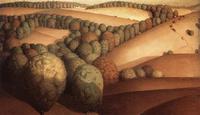
Near Sundown
Grant Wood
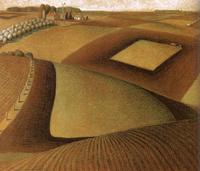
Plowing
Grant Wood
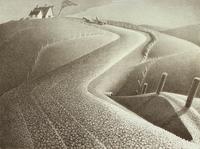
March
Grant Wood
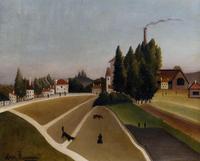
Landscape with Factory
Henri Rousseau
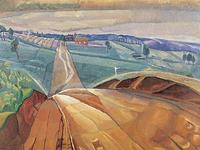
Landscape at Pentecost
Grace Cossington Smith
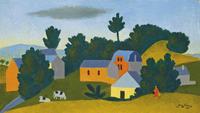
Les deux vaches et la paysanne
Jean Hugo
Evening Landscape
Mstislav Dobuzhinsky
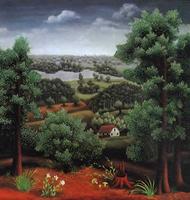
Landscape
Ivan Generalic
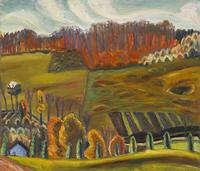
Autumn Fields, Knowlton
Prudence Heward
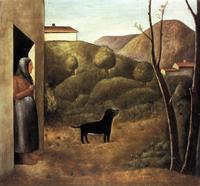
L'attesa
Carlo Carra
Great landscape with trees (The triangular field)
Balthus
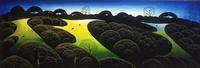
Arroyos
Eyvind Earle

Spring Turning
Grant Wood
Neighborhoods Khvalynsk
Kuzma Petrov-Vodkin
Landscape on the Teggernsee with a reading man
August Macke
A Beautiful World
Grandma Moses
Nameless Hights
Tetyana Yablonska