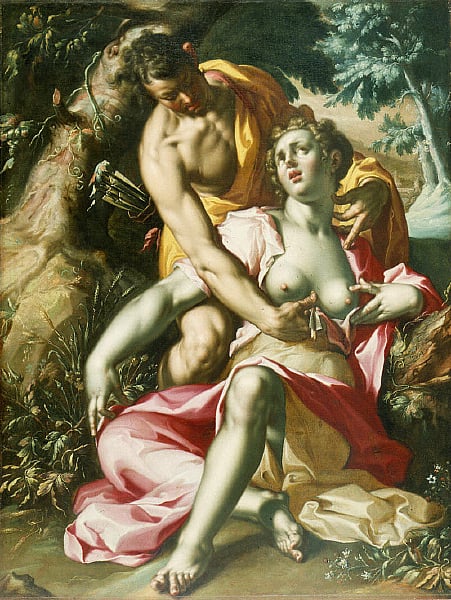
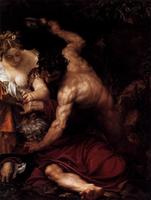
Joachim Wtewael’s Cephalus and Procris (The Death of Procris) is a prime example of Northern Renaissance Mannerism, demonstrating how Dutch artists of the late 16th and early 17th centuries adapted classical mythological subjects with a distinctly Northern sensibility. The work’s significance lies in its fusion of intense emotional drama with the meticulous, polished realism characteristic of the Northern Renaissance. Wtewael employs vivid, almost artificial color and contorted, elegant figures to heighten the tragic moment from Ovid’s Metamorphoses—the accidental killing of Procris by her husband Cephalus. This combination of refined surface detail and heightened, often unsettling emotion exemplifies the Mannerist tendency toward complexity and artifice, while the choice of a mythological narrative reflects the growing humanist interests of the period. As a result, the painting stands as a sophisticated synthesis of classical learning, technical virtuosity, and the expressive ambition that defined the later Northern Renaissance.