
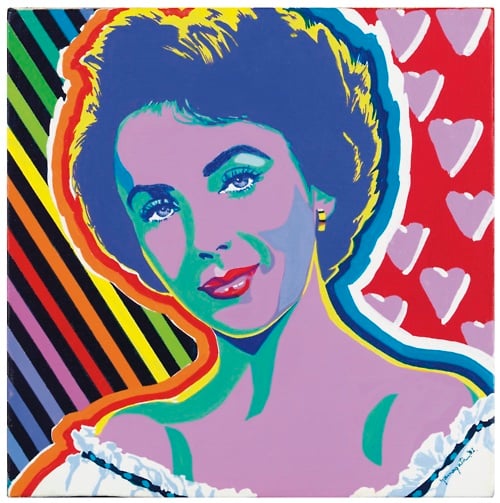
Portrait of Elizabeth Taylor
Analisi esperta di Portrait of Elizabeth Taylor di Hiro Yamagata
Stile: Pop Art · Genere: portrait
Expert Analysis: “Portrait of Elizabeth Taylor” by Hiro Yamagata
As a work of Pop Art, Hiro Yamagata’s “Portrait of Elizabeth Taylor” stands as a significant example of the movement’s core preoccupation with celebrity, mass media, and the flattening of high and low culture. Yamagata, a Japanese artist active in the late 20th century, brings a distinctly global perspective to American Pop conventions, and this portrait of the iconic Hollywood actress crystallizes several key achievements.
1. Elevation of Hollywood Iconography
The choice of Elizabeth Taylor—a defining film star and cultural figure of the mid-20th century—aligns Pop Art’s strategy of treating celebrities as modern-day icons, akin to saints in a secular age. Yamagata’s treatment strips away psychological depth in favor of immediate visual impact, reflecting how mass media reduces complex individuals to vivid, repeating images. This aligns with the work of predecessors like Andy Warhol, yet Yamagata’s rendering often incorporates a lighter, more decorative gloss that typifies later Pop iterations.
2. Use of Vibrant, Graphic Color and Flatness
Characteristic of Pop Art’s rejection of traditional chiaroscuro, Yamagata employs bold, saturated hues and a deliberately flat surface. The portrait likely isolates Taylor’s famous features—her violet eyes, dark hair, and distinct bone structure—into simplified, almost poster-like forms. This flattening technique not only emphasizes the artificiality of celebrity imagery but also connects the portrait to commercial advertising and silkscreen processes, underscoring Pop Art’s critique of commodity culture.
3. Blending Eastern and Western Sensibilities
While firmly rooted in Western Pop, Yamagata’s background introduces a refined attention to pattern and surface elegance. His portraits often possess a polished, high-gloss finish that recalls both Japanese lacquerware and the slickness of Hollywood glamour. This cultural synthesis distinguishes him from his American counterparts and demonstrates how Pop Art’s visual language could be adapted across geographies, broadening the movement’s global significance.
4. Commentary on Fame and Ephemerality
By choosing a star whose career spanned decades, Yamagata also invites reflection on the fleeting nature of fame. The portrait freezes Taylor in an idealized, timeless pose—yet the very Pop style, with its debt to mechanical reproduction, hints at her image being endlessly circulated and consumed. This duality (iconic yet reproducible) is a hallmark of Pop Art’s engagement with the modernity of media.
Significance within the Pop Art Period
Yamagata’s portrait does not merely repeat Warhol’s formulas; it refines them, adding a decorative, almost celebratory quality that moves away from Pop’s earlier irony toward a more affirmative embrace of star power. The work exemplifies how later Pop artists globalized the movement, using Japanese precision and color sensibility to American subject matter. As a result, “Portrait of Elizabeth Taylor” is significant for demonstrating Pop Art’s enduring flexibility and its ability to absorb new cultural lenses while still championing the primacy of the celebrity surface.
Visivamente simili
20 opere con composizione e palette affini
Jane Fonda
Andy Warhol
Red Jackie
Andy Warhol
Diana, Princess of Wales
Diana Ringo
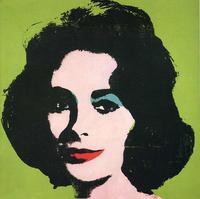
Liz Taylor
Andy Warhol
Portrait
Johannes Meintjes

Taylor Swift Blue
Diana Ringo

🎨 Alcione
Thiago Bortt

Untitled (Joan Crawford says...)
James Rosenquist
Monroe
ILYA CHERVONY

Lady Erika Graetz
Agnes von Angelis AvA

Come Hither
Marjorie Strider

Fräulein Mulino von Kluck
Christian Schad

"I like subtitle - Gena Rowlands"
Malte Sonnenfeld

Nan Kempner
Andy Warhol
Blonder Weiblicher Kopf Mit Blauem Stirnband
Georg Tappert
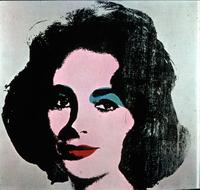
Liz Taylor
Andy Warhol
Lady in Red
Paul Jacoulet
After Marilyn Pink
Andy Warhol
Untitled (from Marilyn Monroe)
Andy Warhol

Marilyn Monroe Artwork in line art
Muntadher Saleh