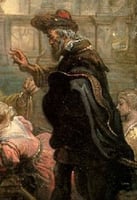
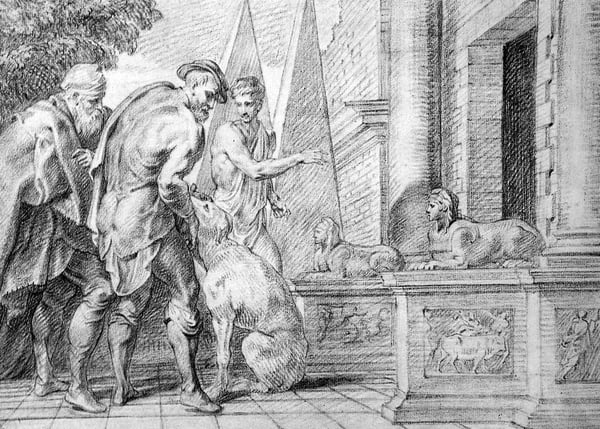
Odysseus Recognised by His Dog
Analisi esperta di Odysseus Recognised by His Dog di Theodoor van Thulden
Stile: Baroque · Genere: mythological painting
Artwork Analysis: Odysseus Recognised by His Dog by Theodoor van Thulden
Style: Baroque
Genre: Mythological painting
Significance within the Baroque Style
As a Baroque mythological painting, van Thulden’s work capitalizes on the era’s fascination with dramatic narrative, emotional intensity, and dynamic composition. The recognition scene—a pivotal moment from Homer’s Odyssey—perfectly embodies the Baroque penchant for capturing an instant of heightened psychological tension. The aging dog Argos, faithful even in decay, provides a vehicle for themes of loyalty, perseverance, and the passage of time, all rendered with the chiaroscuro and vigorous brushwork typical of the Flemish Baroque tradition.
Significance within the Mythological Genre
In the context of mythological painting, van Thulden’s choice of subject is notable for its focus on a quiet, intimate revelation rather than a grandiose battle or divine intervention. This aligns with the Baroque interest in humanizing classical narratives, making them relatable through everyday gestures—a dog’s recognition of its disguised master. The work also reflects the influence of van Thulden’s teacher, Peter Paul Rubens, in its robust figure painting and rich, warm palette. By prioritizing emotional truth over epic spectacle, the painting stands as a nuanced example of mythological storytelling, proving that the most profound heroism can be found in a humble, loyal gaze.
Visivamente simili
20 opere con composizione e palette affini
Cambyses Commanding the Flaying of Judge Sisamnes
Willem van Swanenburg
The Adoration of the Magi
Maerten van Heemskerck
Penelope Announces Odyseus's Return
Theodoor van Thulden
Flagellation
Albrecht Durer
Susanna before Daniel
Willem van Swanenburg
Christ Crowned With Thorns
Albrecht Durer
The Flagellation of Christ in the pavement
Andrea Mantegna
Christ Being Crowned with Thorns
Albrecht Durer
Harrowing Of Hell
Albrecht Durer
Allegory of Justice Depicting a Street Scene with a Shepherd Giving Paper to a Judge, Who Rejects It
Willem van Swanenburg
Achilles Laments the Death of Patroclus 1764
Domenico Cunego
The Flagellation
Albrecht Durer
The Judge Bias, Shedding Tears
Willem van Swanenburg
The Greeks Leave after Fire of Troy
Theodoor van Thulden
Last Supper
Peter Paul Rubens
Judgment of Solomon
Willem van Swanenburg
Bacchanalia with a Wine
Andrea Mantegna
Beheading of the Roman Judge Papinian
Willem van Swanenburg
St. John the Baptist
Hans Holbein the Younger
Death of Cato of Utica
Pierre-Narcisse Guerin