
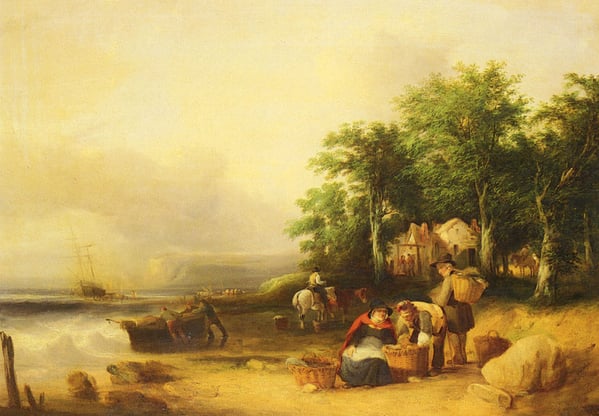
Expertenanalyse zu William Shayers View On The Isle Of Wight
Stil: Romanticism · Genre: genre painting
Expert Analysis of "View On The Isle Of Wight" by William Shayer
This work by William Shayer (1787–1879) is a quintessential example of British Romantic genre painting, bridging the subjective emotionalism of Romanticism with the detailed observation of everyday rural and coastal life. Shayer was particularly known for his landscapes populated with rustic figures, animals, and fishing communities—subjects that appealed to the Victorian taste for the picturesque and the sentimental.
Significance within Romanticism and Genre Painting:
-
The Sublime in the Everyday: Romanticism often sought the sublime in dramatic, untamed nature. Here, Shayer instead finds the picturesque in a domesticated, inhabited landscape—the Isle of Wight, a favored locale for Romantic artists. The painting likely emphasizes the harmonious coexistence of humanity and nature, a gentler Romantic ideal than the stormy Alps or Gothic ruins. The coast, with its shifting tides and open sky, still carries a hint of nature’s power, but it is mediated by the presence of local figures (fishermen, families, or travelers) engaged in daily tasks.
-
Genre as Romantic Expression: As a genre painting, the work elevates the ordinary—beachcombing, carting goods, or simply enjoying the view—to a subject worthy of artistic contemplation. This aligns with Romanticism’s interest in the common person’s experience and the authenticity of rural life, which was seen as a moral counterpoint to industrial urbanity. Shayer’s attention to light, atmosphere, and the textures of sand, sea, and foliage gives the scene a palpable sense of place and moment, inviting the viewer into a shared emotional response.
-
Technical and Artistic Legacy: Shayer’s style, with its soft tonal transitions and careful handling of natural light, reflects the influence of earlier Dutch and Flemish landscape painters as well as the English watercolor tradition. His ability to combine detailed genre elements with a cohesive Romantic mood made his works popular with collectors seeking both narrative charm and atmospheric beauty. View On The Isle Of Wight is significant as a document of how Romanticism in Britain could be intimate rather than epic, finding profound meaning in the coastal scenery and its inhabitants.
In sum, the artwork’s importance lies in its synthesis of Romantic sensibility—feeling, nature, and the passage of time—with the accessible, narrative charm of genre painting, offering a window into the 19th-century British appreciation for both the sublime and the everyday.
Museum / Gallery
Visuell ähnlich
20 Werke mit ähnlicher Komposition und Farbpalette

The End Of The Day
William Shayer
River Wensum
John Crome

Landscape with Sportsmen and Game
Adam Pynacker
Grove Scene
John Crome
The Minnow Catchers
William Collins
Landscape with approaching storm
Josef Kriehuber

At the Cottage Gate
William Collins

Mountainous riverlandscape
Jacob van Strij

Portrait of a couple with two children and a nursemaid in a landscape
Adriaen van de Velde
PAESAGGIO LACUSTRE
Giuseppe Canella

Autumn Landscape
Jacob van Strij

Landscape with a Gypsy Family
George Morland

Unloading The Catch, Near Benchurch, Isle
William Shayer
Mountainous landscape with travellers Sun__Mountainous-landscape-with-travellers
Jacob van Strij

Rider by a pond in a panoramic landscape
Johann Wilhelm Schirmer
The Cottage Door
William Collins

Landschaft mit Figuren
Adolf Methfessel

Forest scene
Jacob van Ruisdael
A Cavalry Travelling Through a Wooded Landscape
Salomon van Ruysdael
Resting in a wooded landscape
Anthonie Jacobus van Wijngaerdt