
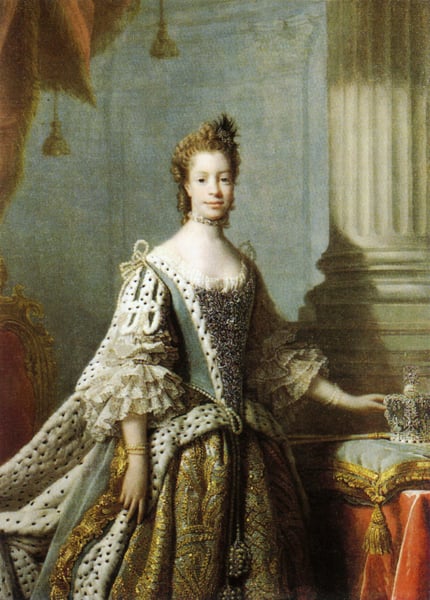
Allan Ramsay sanatçısının Charlotte Sophia of Mecklenburg-Strelitz eseri hakkında uzman analizi
Tarz: Rococo · Tür: portrait
Expert Analysis of Charlotte Sophia of Mecklenburg-Strelitz by Allan Ramsay
Allan Ramsay’s portrait of Charlotte Sophia of Mecklenburg-Strelitz is a masterful example of Rococo portraiture, distinguished by its delicate refinement and its pivotal role in shaping the public image of a British queen. Painted around 1761–62, shortly after her marriage to King George III, the work was not merely a likeness but a carefully constructed symbol of royal grace, virtue, and dynastic legitimacy.
Significance within the Rococo Style
Ramsay’s handling embodies the Rococo’s hallmark elegance: a soft, luminous palette of pastel silks and pearls; fluid, serpentine lines in the sitter’s pose and drapery; and an intimate, almost conversational atmosphere that belies the formality of a state portrait. The queen’s gown shimmers with delicate highlights, while the subtle gradations of rose and ivory in her complexion reflect the Rococo fascination with sfumato and painterly sensuality. Unlike the more bombastic flourishes of earlier Baroque court portraiture, Ramsay achieves a quiet opulence—his brushwork is feathery, his contours softened, drawing the viewer into a sense of personal charm rather than imperial might.
Genre and Courtly Purpose
As a royal portrait, this work fulfills a dual function: it asserts Charlotte’s role as queen consort while also humanizing her. Ramsay avoids the stiff hieratic formulas common to 18th-century state portraits. Instead, he places Charlotte in an ambiguous, lightly shadowed setting, with a landscape glimpsed through a column—a Rococo motif that suggests both natural beauty and the cultivated idyll of monarchy. Her calm, direct gaze and slight smile project intelligence and approachability, qualities that endeared her to the British public and helped stabilize the early reign of George III.
Art Historical Importance
Ramsay’s portrait is significant as one of the defining images of Queen Charlotte, setting a visual template for her subsequent iconography. It also demonstrates how British portraiture, under Ramsay’s influence, merged Rococo decorative finesse with a distinctly British sense of restrained dignity—a style that would later be eclipsed by Sir Joshua Reynolds’ more classical grand manner. The work remains a touchstone for understanding how 18th-century court artists navigated the tension between flattery, realism, and political messaging. In its harmonious balance of airy grace and psychological depth, it stands as a high-water mark of Rococo portraiture in Britain.
Museum / Gallery
Görsel olarak benzer
İlişkili kompozisyon ve renk paletine sahip 20 eser
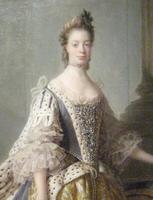
Portrait of Sophia Charlotte of Mecklenburg-Strelitz, wife of King George III
Allan Ramsay
Queen Charlotte
Allan Ramsay
Portrait of Queen Charlotte
Allan Ramsay
Queen Charlotte, Wife of George III
Thomas Lawrence
Marie Leszczinska, Reine De France
Charles-Andre van Loo (Carle van Loo)
Queen Adelaide
John Simpson
Portrait of Catherine II
Aleksey Antropov

Portrait of Augusta of Saxe Gotha
William Hogarth
Queen Victoria (detail)
David Wilkie
Portrait of Princess Isabella of Parma or her mother Louise Élisabeth of France
Jean-Étienne Liotard
Portrait of Queen Charlotte
Joshua Reynolds
Susanna Kennedy, Countess of Eglinton (copy After William Aikman)
Gavin Hamilton
Isabel Cristina de Brunswick-Wolfenbüttel
Antoine Pesne
Portrait of Empress Alexandra Fedorovna
Christina Robertson
Portrait of Catherine II of Russia
Fyodor Rokotov
Queen Victoria
Franz Xaver Winterhalter
The Countess of Dartmouth
Joshua Reynolds

Catherine II
Stefano Torelli
Maria Theresa, Empress of Austria
Marten van Mytens the Younger
Portrait of Empress Elizabeth Petrovna
Charles-Andre van Loo (Carle van Loo)