
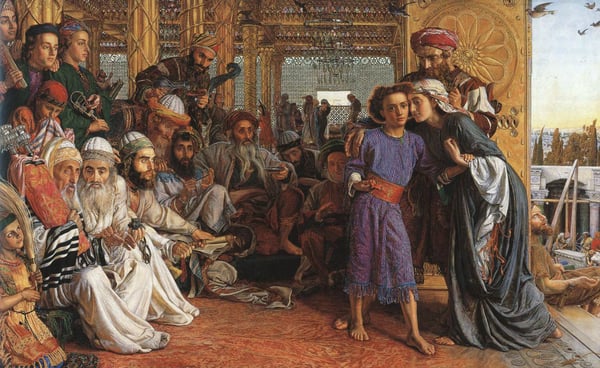
The Finding of the Saviour in the Temple
Détails
Analyse experte de The Finding of the Saviour in the Temple de William Holman Hunt
Style : Romanticism, Orientalism · Genre : genre painting
Expert Analysis: "The Finding of the Saviour in the Temple" (1854–1860) by William Holman Hunt
This work stands at the intersection of Romanticism and Orientalism, operating simultaneously as a genre painting rooted in biblical narrative and a meticulously researched ethnographic document. Hunt, although often associated with the Pre-Raphaelite Brotherhood, employs Romanticism’s emphasis on intense emotion and spiritual revelation, while Orientalism provides the exoticized setting that grounds the scene in what was then considered authentic Near Eastern life.
Significance within Romanticism and Orientalism
- The painting exemplifies Romanticism’s fascination with transcendent moments drawn from scripture. Hunt transforms a familiar Gospel episode into a psychologically charged encounter: the young Jesus, illuminated and composed, stands among rabbinical scholars and his frantic parents. The tension between divine knowledge and earthly confusion is palpable.
- As an Orientalist work, it reflects the 19th‑century European impulse to reconstruct biblical history through the lens of contemporary Middle Eastern culture. Hunt traveled to Jerusalem to study local architecture, costume, and customs, ensuring that the temple’s masonry, the scholars’ turbans and robes, and the Torah scroll are represented with near‑ethnographic accuracy. This fusion of Romantic spirituality with Orientalist “archaeological” realism was groundbreaking: it made the sacred story feel present and verifiable, yet exotic and distant.
Genre Painting as a Tool for Moral Instruction
Though the subject is religious, Hunt treats it as a genre scene—a depiction of everyday life. The temple becomes a crowded, lived‑in space: women gossip, children play, and merchants loiter. By embedding the sacred moment within mundane activity, Hunt asserts that divine truth can break into ordinary experience. This genre approach also invites the Victorian viewer to identify with the figures: Mary’s anxious gesture, Joseph’s bewildered stance, Jesus’ calm authority. The painting’s moral weight lies in this accessibility; it is not a mere illustration but a meditation on family, faith, and the gradual revelation of purpose.
Symbolic and Compositional Innovations
- The central light source—a lantern hanging above Jesus—creates a chiaroscuro reminiscent of Romantic tenebrism, casting the young Saviour in an otherworldly glow while leaving the temple elders in shadow. This underscores the Romantic theme of light (divine knowledge) overcoming darkness (human ignorance).
- Hunt fills the scene with symbolic details: the mosaic floor patterns evoke an ancient cosmos; the censing priest in the background alludes to sacrifice; the scrolls opened at different angles suggest debate over the Law. Every element is deliberate, turning the genre setting into a layered emblem of typology.
- The Orientalist precision is itself symbolic. Hunt’s careful rendering of Jerusalem’s stones and textiles was intended to prove the historicity of the Gospels, countering contemporary skepticism. The painting thus becomes a visual apologia, using Romantic emotional intensity and Orientalist verisimilitude to defend faith.
Legacy
“The Finding of the Saviour in the Temple” is significant because it synthesizes Romanticism’s inner drama with Orientalism’s outward facticity within an accessible genre‑painting framework. It challenged viewers to see the holy not in idealized Italianate settings but in the gritty, sun‑baked authenticity of the 19th‑century Levant. Hunt’s work remains a landmark in Victorian religious art, demonstrating how style and genre can be harnessed to make the devotional both immediate and intellectually compelling.
Museum / Gallery
Visuellement similaire
20 œuvres à la composition et à la palette proches

Interior of a School in Cairo
John Frederick Lewis
The new favorite (Harem scene)
Francesco Hayez
The Wisdom of Solomon
James Tissot
Inside the Harem
Francesco Hayez
And the Prayer of Faith Shall Save the Sick
John Frederick Lewis
In the Harem
Adolphe Yvon
A New Arrival
Giulio Rosati
Favorite of the Farm
Rudolf Ernst
Dancer and favorites
Alfred Dehodencq

Interior of a School in Cairo (detail)
John Frederick Lewis
Еhe Harem - Introduction of An Abyssinian Slave
John Frederick Lewis
St. Francis of Assisi
Gustave Dore
The Terrace
Rudolf Ernst
The Snake Charmer
Jean-Leon Gerome
The Slave Market
Jean-François Portaels
The New Bride
Rudolf Ernst
Nathan Rebukes David, as in 2 Samuel 120
James Tissot

Othello Relating His Battles
Alexandre Cabanel
Die Türkin
Johann Peter Krafft
Nor saw she save the King, who wrought the charm
Eleanor Fortescue-Brickdale