Analisi esperta di Holy Family di Bernhard Strigel
Stile: Northern Renaissance · Genere: religious painting
Expert Analysis: "Holy Family" by Bernhard Strigel
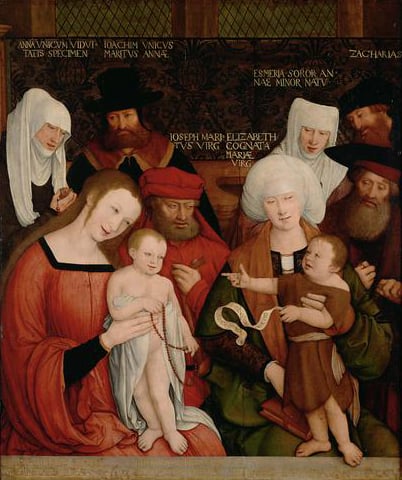
Bernhard Strigel’s Holy Family stands as a quintessential example of the Northern Renaissance’s fusion of meticulous naturalism with profound devotional intimacy. Painted around the early 16th century, the work reflects the period’s shift from medieval iconography toward a more humanized, accessible depiction of sacred figures—a hallmark of Northern European religious painting.
Significance within the Northern Renaissance:
- Detailed Realism and Symbolic Precision: Strigel, like his contemporaries (e.g., Albrecht Dürer, Hans Memling), employs acute observation of texture and light. The fabric folds, the soft modeling of faces, and the domestic setting ground the divine in everyday life—a key Northern Renaissance innovation that made holy narratives relatable.
- Emotional Intimacy: Unlike earlier formal hieratic compositions, Strigel presents the Holy Family in a tender, informal grouping. The Virgin’s gentle gaze, Joseph’s protective posture, and the Christ Child’s playful or contemplative expression create a familial warmth that resonates with viewers, emphasizing the humanity of Christ.
- Symbolic Layers: The painting likely includes subtle Northern Renaissance symbols—such as a window suggesting divine light, fruit alluding to the Fall and Redemption, or flowers indicating purity—which reward close reading. This layered symbolism, typical of the period, blends theological complexity with visual beauty.
- Regional Style and Technique: Strigel, active in Swabia and an associate of the Ulm school, demonstrates the Northern preference for clear contours, rich glazes, and a cool, luminous palette. His work bridges late Gothic spirituality and emerging Renaissance naturalism, marking a transitional moment in German art.
In sum, Holy Family is significant not only for its masterful execution but for how it embodies the Northern Renaissance’s core mission: to make the divine tangible, approachable, and emotionally immediate through meticulous realism and symbolic depth. Strigel’s interpretation remains a moving testament to the era’s enduring influence on religious art.
Museum / Gallery
Visivamente simili
20 opere con composizione e palette affini
Virgin and Child With St. Anne and a Franciscan donor
Hugo van der Goes
St. Mary Salome and Zebedee with John the Evangelist and James the Great
Bernhard Strigel
Madonna with Writing Child and St. Jerome
Pinturicchio
St. Luke Drawing a Portrait of the Virgin Mary
Rogier van der Weyden
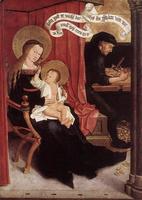
Mary and Joseph with Jesus
Bernhard Strigel
Circumcision
Bartolomeo Veneto
Mystic marriage of St Catherine
Hans Memling
Virgin and Child Enthroned with two Musical Angels
Hans Memling
Virgin and Child between Sts John the Baptist and Catherine
Pietro Perugino
The Mystic Marriage of St. Catherine
Lucas Cranach the Elder
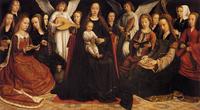
Madonna with Angels and Saints
Gerard David
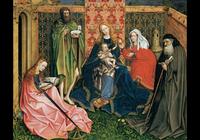
Madonna and Child in a Garden
Robert Campin
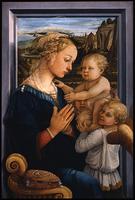
Madonna and Child with two Angels
Filippo Lippi
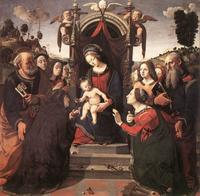
Mystical Marriage of St. Catherine of Alexandria
Piero di Cosimo
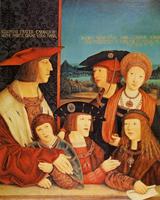
Portrait of Emperor Maximilian and His Family
Bernhard Strigel
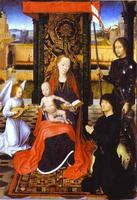
The Virgin and Child with an Angel, St. George and a Donor
Hans Memling
Madonna and Child with Two Cherubim
Antoniazzo Romano
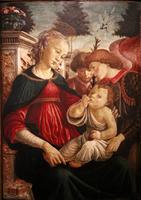
Virgin and child with two angels
Sandro Botticelli
Virgin with the Child and Four Saints
Rogier van der Weyden
Moses's Journey into Egypt and the Circumcision of His Son Eliezer (detail)
Pietro Perugino