
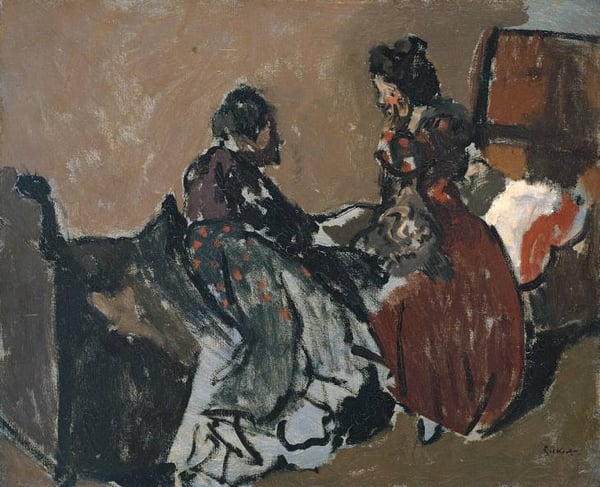
Expert analysis of Walter Sickert’s A Marengo
Style: Impressionism · Genre: genre painting
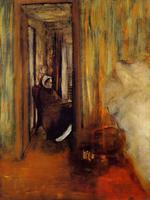
Walter Sickert’s A Marengo is a compelling example of how Impressionist techniques were adapted to convey the gritty, everyday realities of urban life, rather than the more typical scenes of leisure or nature. As a genre painting, it captures a candid moment in a café or restaurant—likely referencing the dish “chicken Marengo” or the Battle of Marengo—but Sickert’s treatment elevates the ordinary into something psychologically charged.
Significance within Impressionism and Genre Painting:
-
Shift from Pastoral to Urban: While early Impressionists often painted sunlit landscapes or bourgeois leisure, Sickert (influenced by Degas) turned to dimly lit interiors and working-class spaces. A Marengo exemplifies this, using a palette of muted browns, grays, and deep shadows to evoke the smoky atmosphere of a Parisian or London eating house. This pushes Impressionism toward a more modern, psychological realism.
-
Loose Brushwork and Ambiguous Narrative: The visible, sketch-like brushstrokes are characteristic of Impressionism, yet here they serve not to capture flickering light but to suggest figures dissolving into their environment. The composition feels almost off-kilter, with cropped forms and a tilted perspective—devices Sickert borrowed from photography and Degas. This ambiguity invites the viewer to construct the story, a hallmark of genre painting’s appeal.
-
Transition to Modernism: A Marengo is significant as a bridge between traditional Impressionism and early 20th-century modernism. Sickert’s focus on dark tonalities, psychological tension, and the mundane poignancy of solitary diners anticipates the work of the Camden Town Group and later Expressionists. The painting demonstrates that Impressionism could be a vehicle not only for sensory pleasure but for subtle social commentary and introspective mood.
In summary, A Marengo is notable for adapting Impressionist methods to the solemn, unglamorous corners of modern life, expanding the possibilities of the genre and paving the way for a more urban, emotionally complex art.
Visually similar
20 works with related composition and palette
In the Red Room
Edouard Vuillard
Sewing Woman
Harriet Backer
After the Ball
Edouard Vuillard
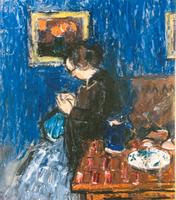
Woman Sewing
Alexandru Ciucurencu
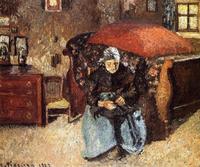
Elderly Woman Mending Old Clothes, Moret
Camille Pissarro
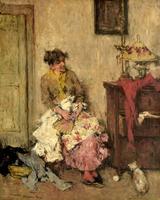
The female mender
Umberto Veruda
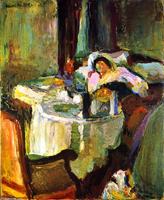
The Invalid
Henri Matisse
Sleeping woman
Isaac Israels
Girl in a White Dress
Samuel Peploe
Young Belgium Women
Walter Sickert
Madame Rene De Gas
Edgar Degas
Woman Sewing
Camille Pissarro
Reading Woman In Violet Dress
Henri Matisse
Alarm Clock
Robert Spencer
Two Women on a Sofa
Walter Sickert
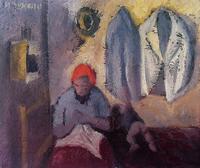
WOMAN WITH BABY
Gerard Sekoto
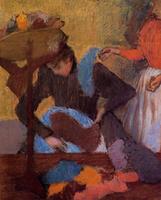
At the Milliner's
Edgar Degas
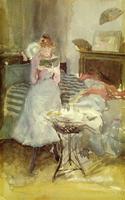
Pink Note: The Novelette
James McNeill Whistler
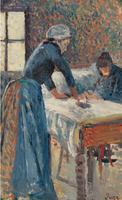
La Repasseuse
Maximilien Luce
The Nurse
Edgar Degas