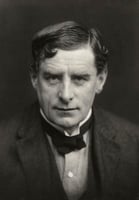
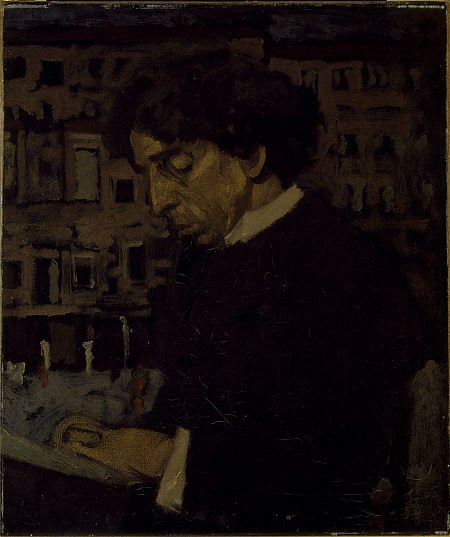
Portrait of Israel Zangwill
Expertenanalyse zu Walter Sickerts Portrait of Israel Zangwill
Stil: Impressionism · Genre: portrait
This portrait marks a fascinating intersection of Impressionist technique and psychological depth, as practiced by Walter Sickert. While Sickert is often grouped with the later Camden Town School, his early work—including this portrait of the prominent writer and Zionist activist Israel Zangwill—reflects a distinctly English adaptation of French Impressionism.
Stylistic Significance: Sickert’s Impressionism here is less about plein-air light effects and more about constructing character through broken brushwork and tonal modulation. The portrait likely employs the subdued, earthy palette Sickert favored, using dabs of color to build form around Zangwill’s face rather than relying on crisp outlines. This technique gives the sitter a sense of immediacy and fleeting presence, as if caught mid-thought—a hallmark of Sickert’s approach to portraiture, influenced by his mentor Degas.
Subject and Context: Israel Zangwill (1864–1926) was a leading literary figure and social commentator, best known for his novel Children of the Ghetto and for coining the term “melting pot.” By painting him, Sickert aligns Impressionist portraiture with intellectual modernism. The portrait’s significance lies in its refusal to flatter or idealize; instead, Sickert uses the impressionist vocabulary to convey the sitter’s restless intelligence and the psychological weight of his public identity.
Within the Genre: In contrast to the more decorative Impressionist portraits of Renoir or the social snapshots of Degas, Sickert’s portraits often carry a narrative or theatrical edge. Here, the loose handling of paint and the likely asymmetrical composition (perhaps a low or tilted viewpoint) create an unsettling modernity, making the work a precursor to the psychological realism that would define early 20th-century British portraiture.
Visuell ähnlich
20 Werke mit ähnlicher Komposition und Farbpalette
Edmond Picard
Jan Toorop
Edmond Picard
Jan Toorop
Self-portrait
Ettore Tito
Portrait of Rodo Pissarro Reading
Camille Pissarro
Self-Portrait against the background of picture "The Conquest of Siberia by Yermak"
Vasily Surikov
Rudolf Steindl, a brother of the artist
Koloman Moser
The Print Collector
Honore Daumier
Czóbel Önarckép
Bela Czobel
Self-portrait
Mykola Yaroshenko
Self-portrait
Isidoro Grünhut
Portrait of Dr. Ferdinand Tribout
Marcel Duchamp
Boy Reading (The Artist's Son)
Samuel Peploe
Self-portrait
Koloman Moser
Seated Young Man in a Jacket with an Umbrella
Edgar Degas
Self-Portrait
Henri Matisse
The beggar of Livorne
Amedeo Modigliani
Portrait of Georges Riviere
Pierre-Auguste Renoir
Portrait of the artist's father
Antonio Mancini
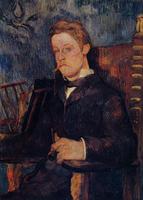
Portrait of a seated man
Paul Gauguin
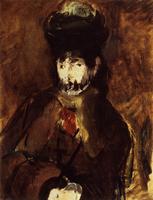
A veiled young woman
Edouard Manet