
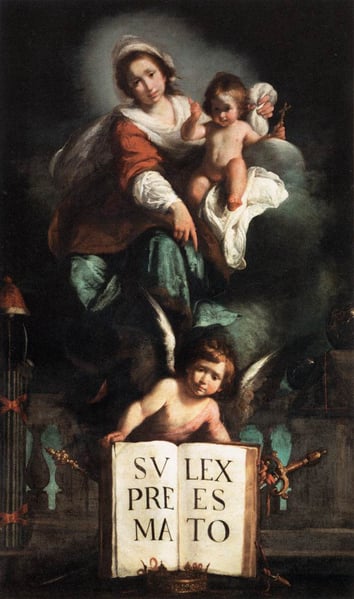
Expertenanalyse zu Bernardo Strozzis The Madonna of Justice
Stil: Baroque · Genre: religious painting
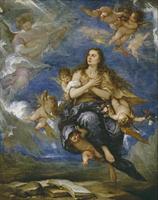
Expert Art Historical Analysis: The Madonna of Justice by Bernardo Strozzi
Context and Style Bernardo Strozzi (1581–1644), a leading figure of the Genoese Baroque, was renowned for his fusion of Venetian colorism—inherited from Titian and Veronese—with the robust naturalism and emotional immediacy demanded by Counter-Reformation religious art. The Madonna of Justice exemplifies the Baroque period’s preoccupation with dynamic composition, dramatic chiaroscuro, and the direct, affective engagement of the viewer.
Iconography and Significance As a religious painting, The Madonna of Justice presents the Virgin Mary not merely as a passive intercessor but as an active, authoritative figure embodying divine judgment tempered with mercy. Strozzi here synthesizes two key Counter-Reformation themes: the Virgin as the merciful Advocate (a common Baroque motif) and the concept of divine Justice—central to Catholic doctrine after the Council of Trent. The title itself is striking: by personifying Justice in the Madonna, Strozzi elevates her role from gentle intercessor to a more powerful, almost judicial presence, reflecting the Church’s contemporary emphasis on the Virgin’s co-redemptive role.
Stylistic Hallmarks of Baroque Significance Strozzi’s handling of light and shadow—a hallmark of the Baroque—invests the scene with spiritual urgency. The Madonna is typically illuminated with a radiant, unearthly glow, her face and gesture conveying both authority and compassion. This dual nature is key: Baroque religious art aimed to move the faithful through sensory immediacy and emotional contrast. The composition likely employs a dynamic diagonal or a swirling movement of drapery, typical of Strozzi’s energetic forms, guiding the viewer’s eye toward the Madonna’s face or toward a symbolic attribute of justice (e.g., scales or sword, though not specified in the facts, the title implies such iconography).
Strozzi’s Unique Synthesis What makes The Madonna of Justice significant within Baroque painting is Strozzi’s ability to blend the decorative richness of the Venetian tradition with the psychological intensity of Genoese realism. Unlike the more theatrical, often overtly dramatic works of his Roman contemporaries (such as Caravaggio or Bernini), Strozzi’s religious images retain a contemplative, almost lyrical quality. In this work, the balance between celestial authority and human empathy reflects the broader Baroque goal of making the divine accessible through tangible, emotionally resonant forms.
In summary, The Madonna of Justice stands as a testament to Strozzi’s mastery of Baroque principles: it uses light, color, and movement to convey a complex theological message, adapting the Virgin’s traditional intercessory role to a more robust, justice-oriented Counter-Reformation spirituality. The painting’s significance lies in its successful integration of doctrinal ambition with the era’s signature aesthetic of dramatic, persuasive visual rhetoric.
Museum / Gallery
Visuell ähnlich
20 Werke mit ähnlicher Komposition und Farbpalette
Saint Michael dedicating his weapons to the Virgin
Le Nain brothers
Madonna of the Swallow
Guercino

Annunciation
Giovanni Battista Tiepolo
Urania and Erato
Sebastiano Conca
The Annunciation
François Lemoyne

Annunciation to the Virgin
Jacob de Wit
The Annunciation
Luca Giordano

Cristo En El Jardín De Getsemaní
Sebastiano Conca

Allégorie De La Renommée
Sebastiano Conca
The Madonna of the Rosary
Bartolome Esteban Murillo

The Ecstasy of Saint Mary Magdalen
Luca Giordano
Holy Family with St Anne, the Baptist and Zacharias
Sebastiano Conca

Angel
Vicente López Portaña

Saint John the Evangelist's Vision of Jerusalem
Alonzo Cano
Le Christ au Mont des Oliviers
Jacob van Schuppen

The Guardian Angel
Pietro da Cortona
Assumption of the Virgin
Juan Carreno de Miranda
Holy Family with St. John the Baptist
Bernardo Strozzi
Madonna and Child with Putti
Rosso Fiorentino
Assumption of Mary Magdalene
José Antolínez