
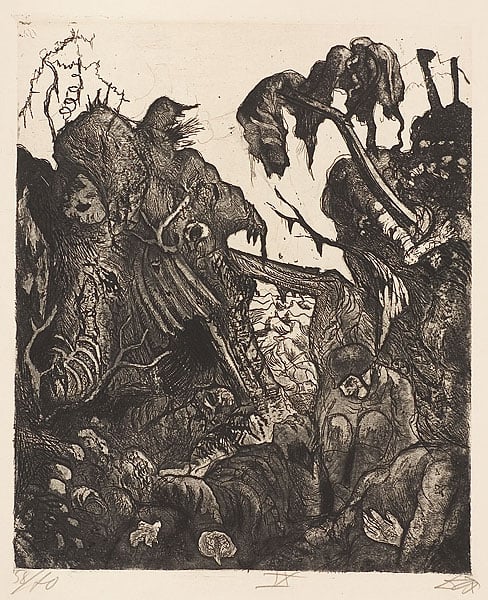
Экспертный разбор работы «Disintegrating Trench» художника Otto Dix
Стиль: Expressionism · Жанр: battle painting
Expert Analysis: Disintegrating Trench by Otto Dix (1924)
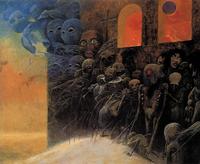
Otto Dix’s Disintegrating Trench stands as one of the most unflinching visual indictments of World War I ever committed to canvas. Created within the Expressionist tradition, the work exemplifies the movement’s core aim: to distort objective reality in order to convey raw emotional and psychological truth. For Dix, a veteran of the trenches, this meant abandoning any pretense of heroic or patriotic battle narrative. Instead, he presents a scene of grotesque decay—a collapsed, muddy excavation littered with the fragmented remains of soldiers, their bodies merging with the churned earth.
What makes it significant within its style and genre?
First, Disintegrating Trench pushes battle painting to its breaking point. Traditional battle art (from Renaissance to 19th-century academic) typically glorified commanders, celebrated victories, or organized chaos into a noble composition. Dix overturns this entirely: there are no adversaries, no clear action, no triumphant flag. The only “action” is the slow, irrevocable disintegration of matter—wood, cloth, flesh, and bone all sinking into a hellish mire. This is the genre turned inside out, focusing on the aftermath and the decomposition of both body and meaning.
Second, as Expressionism, the work is radical in its treatment of color and form. Dix employs a palette dominated by sickly yellows, putrid greens, and sludgy browns—colors that evoke rot, infection, and the gas‑poisoned air of No Man’s Land. His brushwork is harsh, almost violently impasto, creating a tactile sense of decay. The faces (or what remains of them) are not individualized but reduced to gaping skulls or featureless masks, stripping the soldiers of identity and reducing them to universal symbols of war’s waste. The composition itself—a diagonal collapse of earth and bodies—pulls the viewer’s eye downward into the pit, a spatial metaphor for moral and physical gravity.
Finally, the work’s significance lies in its historical and psychological accuracy. Dix was a participant in the slaughter he depicts; his expressionist distortion is not a stylistic choice alone but a record of trauma. The “disintegrating” trench is not just a physical site but a metaphor for the breakdown of pre‑war European civilization. Dix forces the viewer to confront what official propaganda erased: the fact that war does not produce heroes but ruins.
In sum, Disintegrating Trench is a masterwork of Expressionist anti‑war art. It redefines the battle painting genre by replacing spectacle with squalor and rhetoric with rot, and it remains a searing reminder that the most truthful war art is often the hardest to look at.
Визуально похожие
20 работ с близкой композицией и палитрой
Untitled
Antonio Areal
Vajda Lajos Ősnövényzet 1940 Szén Papír 900x1260
Vajda Lajos
Untitled
Zdzislaw Beksinski
Untitled
Zdzislaw Beksinski
Bursting Head
Nabil Kanso
Untitled
Zdzislaw Beksinski
Root trolls
John Bauer
Untitled
Zdzislaw Beksinski
The Temptation of St. Anthony
Ivan Albright
Warning
Ivan Marchuk
The Cheerful Horse
Salvador Dali
WELTENWANDEL
Jürgen Bley
Untitled
Albin Brunovsky
Mime, howling. Ohé! Ohé!
Arthur Rackham
The Water is a Naked Box
Arnulf Rainer
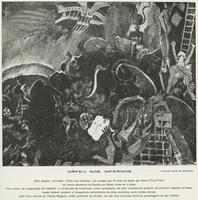
Orfeu nos Infernos
Guilherme de Santa-Rita
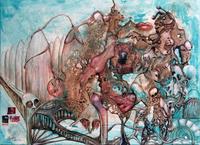
Liebe Tot und Teufel
Jürgen Bley
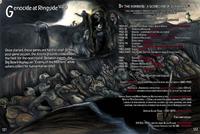
Genocide
Sue Coe
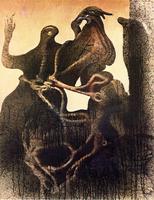
Birth of Zoomorphic Couple
Max Ernst
Untitled
Zdzislaw Beksinski